 blog
blog
Best Low Voltage Landscape Lighting: 2026 Buyer's Guide
Table of Contents
- Why Low Voltage Lighting Wins on Safety, Cost, and Design Flexibility
- Fixture Types That Define the Best Low Voltage Landscape Lighting Systems
- Low Voltage Landscape Lighting Wire Gauge Guide: Sizing Cable for Voltage Drop
- Landscape Lighting Transformer Sizing: Matching Wattage to Your Layout
- Professional Landscape Lighting Design Tips for Layered, Glare-Free Results
- Smart Home Integration and Long-Term Cost of Ownership
- Regional Climate Considerations and Weatherproofing Ratings
- Conclusion
- Frequently Asked Questions
Last Updated: September 16, 2026
Why Low Voltage Lighting Wins on Safety, Cost, and Design Flexibility
The best low voltage landscape lighting runs on 12V AC instead of standard 120V household current, which is why it dominates residential and light commercial projects. A 12-volt system poses minimal shock risk, so it can sit closer to soil, water features, and walkways without the code-driven depth and conduit rules that apply to line voltage.
That safety margin buys real design freedom: cable through planting beds, fixtures tucked under shrubs, path lights inches from a stone walkway, no trenching equipment or electrical rough-in required.
Fixture Types That Define the Best Low Voltage Landscape Lighting Systems
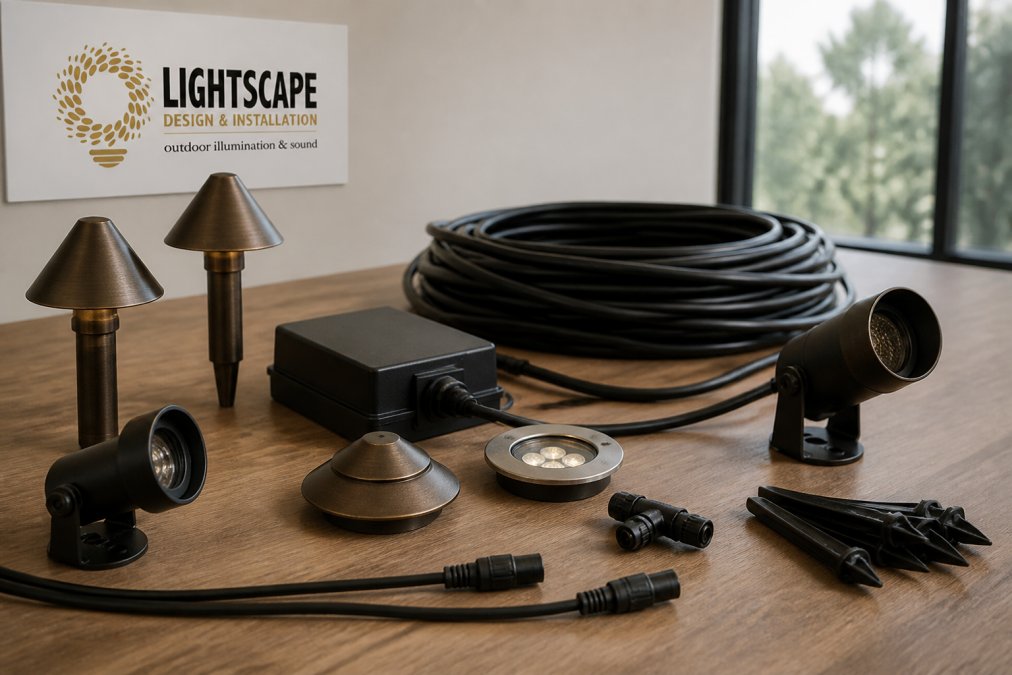
The best low voltage landscape lighting systems combine four fixture families, each doing a distinct job rather than duplicating the others.
| Fixture Type | Typical Mount | Best For | Beam Character |
|---|---|---|---|
| Path lights | Stake, 18-24 in | Walkways, beds | Downward pool |
| Spotlights | Stake or tree mount | Trees, facades, signs | Narrow, aimable |
| Well lights | Flush, in-ground | Columns, walls, uplighting | Upward graze |
| Hardscape | Wall, step, seat wall | Patios, steps, retaining walls | Downward or grazing |
Low Voltage Landscape Lighting Wire Gauge Guide: Sizing Cable for Voltage Drop
Voltage drop is the quiet killer of low voltage systems. A low voltage landscape lighting wire gauge guide matters because 12V circuits lose voltage over distance far faster than 120V circuits do: a run starting at 12.0 volts at the transformer may deliver only 10.5 volts at the last fixture, dimming output and shortening LED life.
How to Calculate Voltage Drop Before You Bury Cable
Voltage drop equals current times resistance times distance, with distance doubled for the round trip. In practice: estimate total wattage on the run, divide by 12 volts for amperage, then check that against the cable's resistance per foot. If drop exceeds roughly half a volt on a 12V circuit, step up a gauge or split the run.
Landscape Lighting Transformer Sizing: Matching Wattage to Your Layout
A landscape lighting transformer sizing decision comes down to total connected wattage plus headroom. Add up every fixture's rated wattage on the circuit, then choose a transformer rated at least 20 to 30 percent above that total. The headroom absorbs future additions and keeps the transformer off its thermal limit.
Multi-Tap Transformers and Why the Tap You Choose Matters
Most professional-grade transformers are multi-tap, with output broken into terminals delivering slightly different voltages, commonly 12, 13, 14, and 15 volts. The reason is voltage drop: land a long home run on the 14- or 15-volt tap and a short run on the 12-volt tap, and both ends of the property see roughly the same voltage at the fixture. Wrong tap choice is the second most common cause of a dim far end after undersized cable.
12V AC vs. Integrated LED Systems and Dusk-to-Dawn Control
Traditional 12V AC systems use replaceable lamps, meaning periodic bulb swaps and matched wattage across fixtures. Integrated LED builds the light engine into the housing, so there are no bulbs to replace and color temperature stays consistent. Pair either with a dusk-to-dawn sensor or photocell and the system runs itself, on at sunset and off at sunrise.
Professional Landscape Lighting Design Tips for Layered, Glare-Free Results
Working With Mature Trees, Patios, and Long Shadows
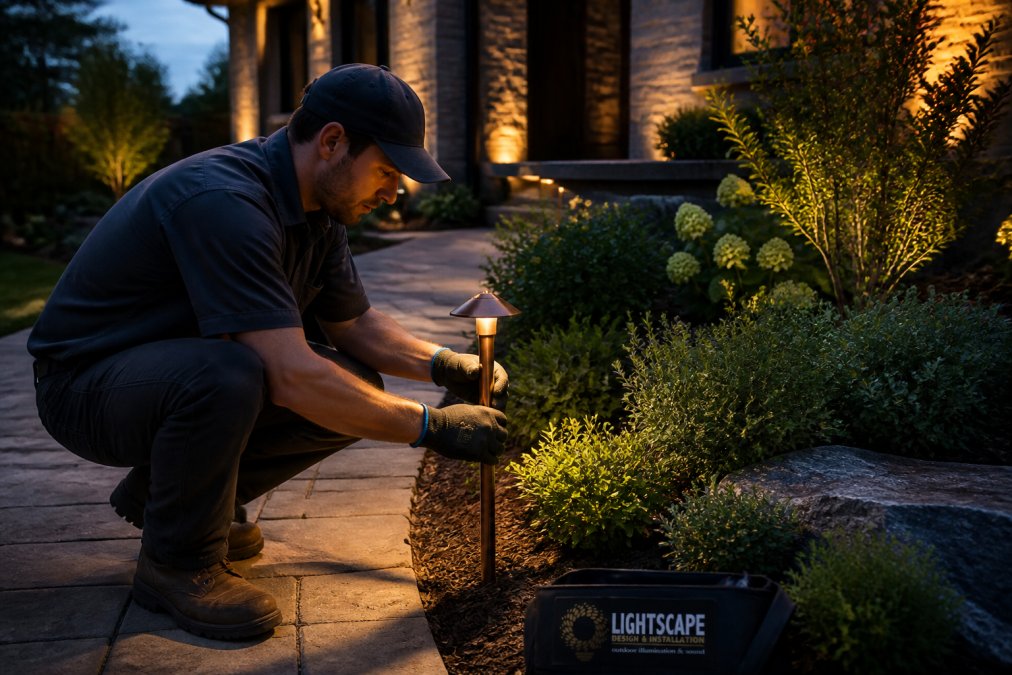
Mature oak canopies are the obstacle homeowners raise most. A dense canopy blocks ground uplighting, so mount fixtures in the tree itself or graze the trunk and lower limbs instead of lighting the whole crown. On patios, recessed well lights and step lights define the space without glare and extend how late it stays usable.
Smart Home Integration and Long-Term Cost of Ownership
Smart home integration is where low voltage systems have changed most in recent years. Low voltage is easy to automate because the transformer already steps 120V household current down, so the control layer sits on the low-voltage side where risk and wiring complexity are minimal. You can add scheduling, dimming, and zone control without opening a wall or pulling a permit in most cases.
Call to schedule a consultation →
How Smart Control Actually Wires In
There are three common integration paths, and they differ in how much they lock you into one ecosystem.
- Smart transformer with a built-in app. The control radio lives inside the transformer housing. You get scheduling, dimming, and zone control from the manufacturer's app, and setup is a matter of pairing the transformer to your Wi-Fi network. The trade-off is ecosystem lock-in: the transformer talks to its own app, and third-party integration varies by model.
- Low-voltage smart controller added to an existing transformer. A small inline controller sits between the transformer and the cable run, switching and dimming zones on a schedule. This is the retrofit path for a system that already works but has no smart features.
- Hub-based integration. A smart home hub bridges the lighting to a broader automation platform, so a single scene can dim the patio lights, close the shades, and set the thermostat. This is the path that delivers true voice control and cross-device scenes, and it's the one most guides skip.
What Smart Control Actually Buys You
The practical payoff is zone independence. Split a property into zones and the front entry, patio, and driveway each run on their own schedule: security lighting on dusk-to-dawn every night while entertaining zones stay dark until triggered. Dim the whole property to 30 percent for a dinner party without touching a fixture, and check from your phone whether you left the patio lights on.
The 10-Year Cost of Ownership Math
Long-term cost of ownership favors integrated LED over halogen by a wide margin, large enough that the higher upfront price is recovered well inside the fixture's life. Halogen draws far more wattage for the same output and burns out on a predictable schedule, so you pay twice: energy, then replacement lamps and labor. Integrated LED draws a fraction of that wattage and holds output for years.
Regional Climate Considerations and Weatherproofing Ratings
Climate decides which fixtures survive. In the Midwest, the punishing combination is summer humidity, winter freeze-thaw cycles, and heaving soil. Fixtures rated for wet locations and built from brass or copper handle that far better than thin aluminum housings that trap moisture and corrode from the inside.
Conclusion
Getting low voltage lighting right comes down to unglamorous details: correct wire gauge, a properly sized transformer, sealed connectors, and fixtures aimed at surfaces instead of eyes. Those decisions separate a system that looks intentional for twenty years from one that flickers and dims within three.
Frequently Asked Questions
What is the best wattage for low voltage landscape lighting?
Wattage depends on the fixture's job. Path lights typically run 3 to 7 watts, spotlights and uplights 7 to 15 watts, and wash fixtures 10 to 20 watts. Integrated LED fixtures list wattage and lumens together, so compare lumens first and watts second. Keep total fixture wattage under 80% of your transformer's rated capacity to leave headroom for voltage drop and future additions.
What size wire is best to run for outside landscape lights low voltage?
Most residential runs use 12-gauge or 10-gauge direct burial cable. Twelve-gauge works for shorter runs and lighter loads, while 10-gauge handles longer distances and higher total wattage with less voltage drop. A low voltage landscape lighting wire gauge guide helps you match gauge to run length and load so the last fixture stays as bright as the first.
Are LED low voltage lights better than halogen?
Integrated LED fixtures use roughly 75% less energy than halogen and last for years instead of months, so there are no bulbs to replace. They also run cooler, which matters for fixture housing and nearby plant material. Halogen gives a slightly warmer glow, but LED color temperature options from 2700K to 3000K now match that warmth closely.
How do I choose the right transformer for low voltage lighting?
Add up the wattage of every fixture, then choose a transformer rated at least 20% higher than that total. Landscape lighting transformer sizing also depends on run length, since voltage drop grows with distance. A transformer with multiple taps or zones lets you split long runs and keep brightness even across the whole system.