 blog
How to Choose the Best Landscape Lighting for Pools
Last Updated: October 28, 2026
Quick Summary
The best landscape lighting for pools layers soft light in the water, controlled light on the deck, and warm light in surrounding trees and garden, using low-voltage fixtures rated for wet locations. Choose sealed, integrated LED fixtures with GFCI-protected feeds and professional installation to control glare and survive chlorine, splash, and sun.
- Low-voltage pool systems still need a listed transformer and a GFCI-protected feed.
- Light what surrounds the water, not just the water, so the pool anchors a composed scene.
- Space path lights apart and aim them outward to avoid glare and a runway effect.
- Choose fixtures with a UL wet-location listing, not just a damp rating, near splash zones.
- Lightscape specifies USA-made integrated LED fixtures backed by a 20-year limited warranty.
Table of Contents
- Why Pool Areas Need Purpose-Built Landscape Lighting
- Low-Voltage Landscape Lighting vs. 120-Volt Systems
- Pool Landscape Lighting Ideas That Actually Work
- Pool Pathway Lighting: Guiding Feet, Not Blinding Eyes
- Pool Step Lighting for Safe Entry and Exit
- Fixture Ratings, Durability, and What to Look For
- Brightness, Color Temperature, and Glare Control
- Schedule a Nighttime Lighting Demo for Your Pool Area
- Frequently Asked Questions
Why Pool Areas Need Purpose-Built Landscape Lighting
The best landscape lighting for pools starts with one idea: water changes everything about how light behaves. A fixture that looks perfect beside a stone wall can throw a blinding reflection across a pool surface. Pool-area lighting design can account for reflection, safety, and how people use the space after dark.
Pool lighting is the practice of illuminating a pool, its surrounding deck, and nearby landscaping so the area stays safe, usable, and attractive at night. It differs from general yard lighting because water amplifies glare, wet surfaces demand better traction lighting, and the mix of underwater and above-ground sources has to feel like one scene, not five separate ones.
The fix is layering: soft light in the water, controlled light on the deck, and warm light in the trees and garden beyond.
Low-Voltage Landscape Lighting vs. 120-Volt Systems
Low-voltage landscape lighting runs on a transformer that steps household current down to a safer level, while 120-volt systems use standard line voltage and require different wiring and protection. Near a pool, the choice of system involves electrical safety as well as convenience.
Any electrical work near a pool has to follow local code and be handled by qualified professionals.
Pool-Specific Electrical Safety Considerations
Water and electricity demand respect.
- Ground-fault circuit interrupter (GFCI) protection is required for most pool-area circuits. A GFCI cuts power when it senses a ground fault, and it is your first line of defense against shock.
- Equipotential bonding ties together metal parts of the pool structure, the water, and nearby metallic equipment so they stay at the same electrical potential. This is a code requirement for inground pools and is separate from grounding.
- Low-voltage systems still need a listed transformer and proper connections. The lower voltage reduces risk, but it does not eliminate the need for code-compliant installation.
- Licensed electrician territory: any work on the 120-volt side, the transformer feed, pool bonding, or line-voltage fixtures, should be performed by a licensed electrician. Many jurisdictions also require a permit and inspection for pool-area electrical work.
If you are still weighing system types, our guide to the best low voltage landscape lighting walks through fixtures, transformers, and wire gauge planning in detail.
| Factor | Low-Voltage System | 120-Volt System |
|---|---|---|
| Typical use | Gardens, paths, pool surrounds | Structures, high-output areas |
| Fixture size | Compact, easy to conceal | Larger housings |
| Wiring | Shallow trench, flexible cable | Deeper runs, conduit |
| Adjustment | Simple to add or move fixtures | More involved |
| Best for | Layered residential design | Fixed architectural loads |
| Pool-area safety | Lower voltage, but still requires listed transformer and GFCI-protected feed | Requires licensed electrician, bonding, and GFCI protection |
Pool Landscape Lighting Ideas That Actually Work
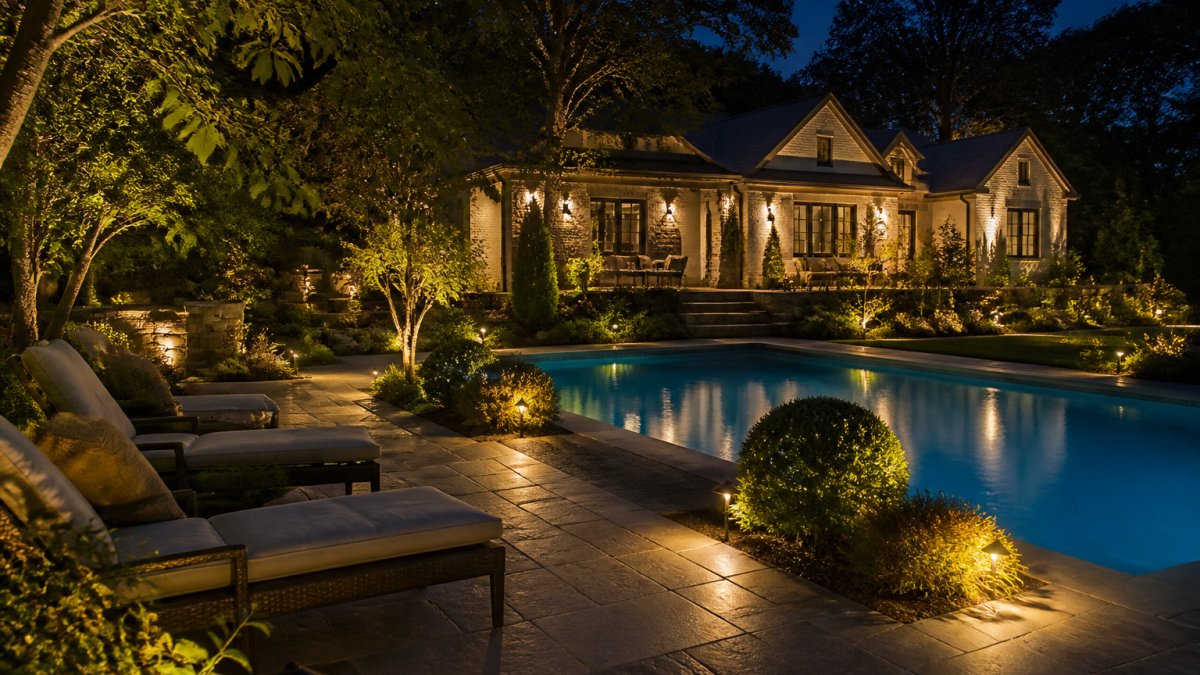
Good pool landscape lighting ideas share one trait: they light what surrounds the water, not just the water. The pool becomes the center of a composed scene rather than a spotlight in a dark yard.
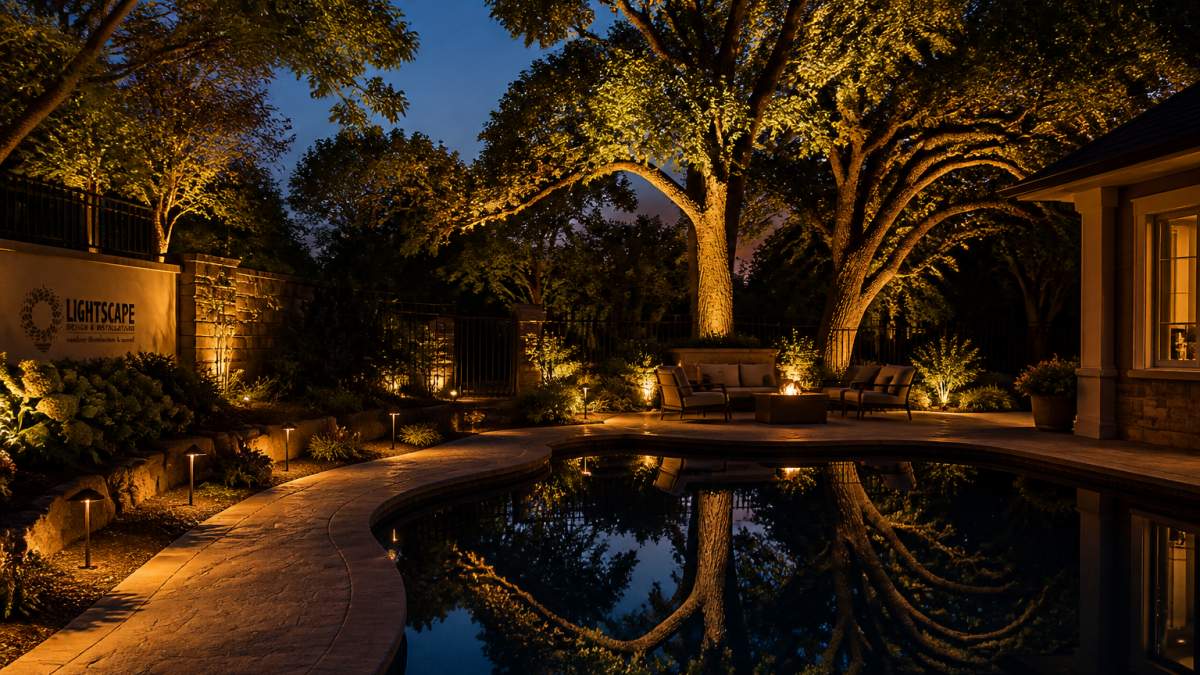
Here is what we see work best:
- Tree uplighting behind the pool, so canopies glow and reflect softly in the water
- Hardscape lighting tucked into retaining walls and seat walls for a low wash of light
- Garden and bed lighting to graze shrubs and give the deck a soft backdrop
- Underwater LED lights for a clean glow inside the pool itself
- Poolside seating light from a low bollard or pendant, kept away from eye level
A few well-aimed fixtures and darker spaces between them can contribute to a composed scene.
Pool Pathway Lighting: Guiding Feet, Not Blinding Eyes
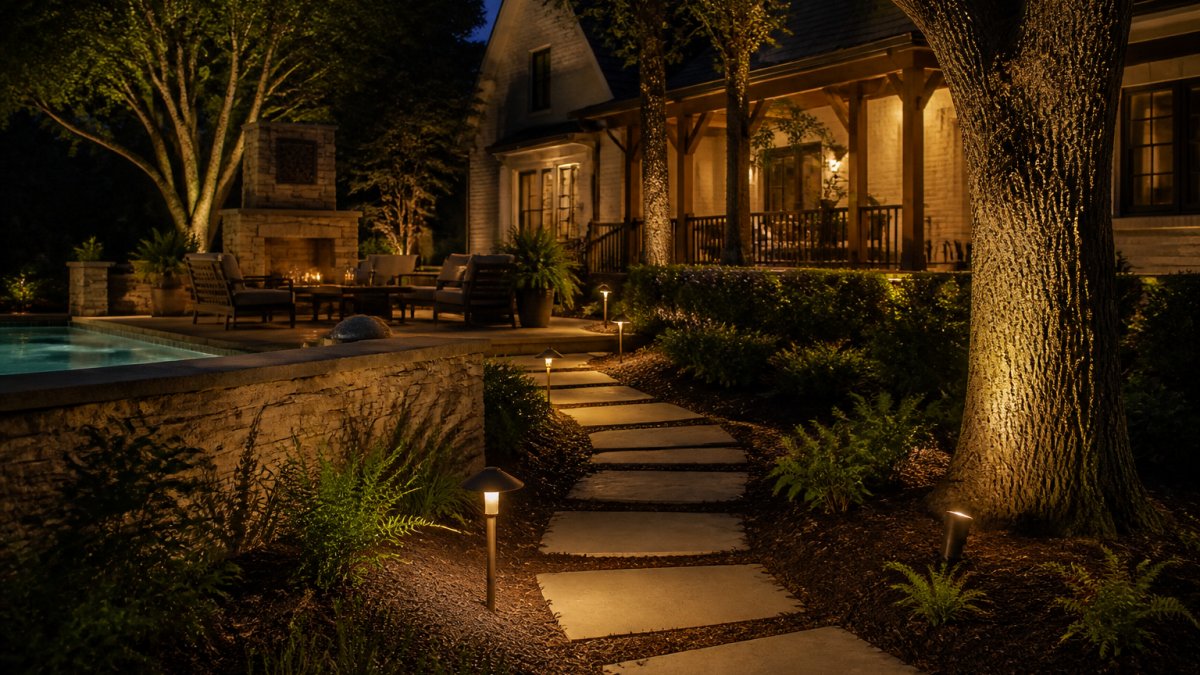
Pool pathway lighting marks the route around the water without shining into anyone's eyes. The goal is a clear, low pool of light on the walking surface and nothing more.
Spacing matters more than brightness. Path lights set too close together create a runway effect, and fixtures aimed outward throw glare at seated guests. Path lights can be set to wash the walkway, shield the source, and keep the beam below eye level. For a full walkthrough of layout and spacing, see our guide to installing path lights in STL.
Watch out: path fixtures placed between the pool and the seating area will bounce light off the water and straight into faces. Move them to the outer edge of the walk instead.
Pool Step Lighting for Safe Entry and Exit
Pool step lighting can help make changes in elevation more visible.
Request a Lighting Consultation Today →
Integrated LED fixtures hold a consistent color and output over time, which matters here: mismatched step lights look like a maintenance problem even when nothing is broken.
Fixture Ratings, Durability, and What to Look For
Poolside fixtures live a harder life than garden fixtures. Chlorine, splash, sun, and freeze-thaw cycles all attack the housing, the lens, and the connections. Durability is the specification that decides whether a system still looks right in year ten. Most buying guides say "look for waterproof fixtures" and stop there. Here is what the ratings actually mean and how to compare them. For a closer look at specific models, see our picks for durable outdoor lighting fixtures.
Ingress Protection (IP) Ratings
An IP rating tells you how well a fixture keeps out solids and moisture. The first digit covers dust and debris; the second covers water. For pool surrounds, you want a fixture rated for at least splash exposure, and for fixtures near the coping or in the splash zone, a higher water rating is worth the cost. A fixture rated only for rain may not survive repeated chlorinated splash.
UL Wet-Location Listing
Look for a UL listing that specifically covers wet locations. A "damp location" rating is not enough for a fixture that will be splashed or sit in standing water after a storm. Wet-location listing means the fixture has been tested for direct water exposure, and it is the minimum standard for anything within reach of pool splash.
Materials That Survive Chlorine and Sun
- Marine-grade stainless steel or powder-coated aluminum housings resist corrosion better than painted steel.
- Sealed lenses with silicone gaskets keep moisture out of the LED chamber and prevent fogging.
- Integrated LED technology with no replaceable bulbs eliminates the socket and bulb seal that often fails first in wet environments.
- Consistent color temperature across every fixture in the run matters here: mismatched step lights look like a maintenance problem even when nothing is broken.
Placement Changes the Spec
At Lightscape Design & Installation, we specify USA-made fixtures with integrated LED technology and back them with a 20-year limited fixture warranty.
Brightness, Color Temperature, and Glare Control
Brightness, color temperature, and glare control decide whether a pool area feels elegant or looks like a parking lot. Lumens measure output, color temperature sets the warmth, and glare control keeps the source out of sight.
Wattage and beam spread are customized per fixture. Shielded and well-aimed fixtures can keep light on the surface and out of the eyes.
If glare has been a problem on your property, our guide to avoiding harsh outdoor lighting glare covers shielding and aiming techniques step by step.
Schedule a Nighttime Lighting Demo for Your Pool Area
A lighting plan is easy to describe and hard to imagine. That is why we demonstrate it.
At Lightscape Design & Installation, we offer a complimentary on-site consultation. Our systems use USA-made fixtures and integrated LED technology, backed by a 20-year limited fixture warranty. We are licensed, bonded, and insured. Alongside landscape lighting design and installation, we offer architectural outdoor lighting.
You can contact Lightscape Design & Installation to schedule a consultation.
Frequently Asked Questions
What is the best lighting for around a pool?
A layered lighting design can include pathway lighting, step lighting, and tree uplighting. Integrated LED technology means there are no bulbs to replace. A professional design can consider the area's appearance and visibility.
Are landscape lights safe to use near a swimming pool?
The safety of lighting near a pool depends on the specific installation. Consult a qualified professional about the requirements for your pool area.
How do you light a pool area without creating glare?
Thoughtful fixture placement and customized wattages and beam spreads can help create purposeful illumination. Contact Lightscape Design & Installation to discuss a complimentary on-site consultation.
Where should landscape lights be placed around a pool?
Pathway and step lighting, tree uplighting, and hardscape lighting are options to discuss with a lighting professional. Fixture placement can be planned to provide purposeful illumination.
Your pool is one of the hardest outdoor spaces to light well, and one of the most rewarding when it is done right. Lightscape Design & Installation designs pool-area systems with shielded fixtures, consistent color, and layered light that flatters the water instead of fighting it. Get started with Lightscape Design & Installation and see your property after dark the way it was meant to look.