 blog
How to Decide if Brass Landscape Lighting Is Worth It
Last Updated: November 2, 2026
Quick Summary
Yes, brass landscape lighting is worth it for homeowners who plan to stay, because solid brass resists rust and corrosion and can last for decades while cheaper housings fail. Brass removes replacement events, and replacement labor often costs more than the fixture itself.
- Brass forms a protective surface layer as it ages, while aluminum corrodes at seams and edges.
- Ask whether a housing is solid brass or brass-finished before you buy.
- A practical yearly routine is rinsing fixtures, wiping lenses, and checking aim and water intrusion.
- Solid brass develops an even patina, which is not damage, peeling, or rust.
- Skip brass for rentals, temporary setups, or fixtures likely to be struck by equipment.
Table of Contents
- Why Brass Landscape Lighting Commands a Premium
- Brass vs Aluminum Landscape Lighting: What the Metal Actually Does
- What Separates Solid Brass Outdoor Lighting Fixtures From Brass-Finished Ones
- Durability, Service Life, and the Case for Fewer Replacements
- Brass Landscape Lights Maintenance: What Owners Actually Do Each Year
- Patina, Finish, and Whether Your Brass Will Change Color
- When Brass Is Not Worth the Premium
- Schedule a Nighttime Lighting Demonstration
- Frequently Asked Questions
Why Brass Landscape Lighting Commands a Premium
Brass landscape lighting costs more up front than almost any other fixture material, and the reason is simple: the metal itself lasts.
The math only works when you stop thinking about the purchase and start thinking about the next twenty years.
Here is the honest version: brass is not the cheapest way to light a yard. It is often the cheapest way to light a yard once.
The Total Cost of Ownership Math Most Buyers Never Run
Most landscape lighting comparisons stop at the sticker on the fixture. That is the wrong number to compare. The number that matters is what a system costs to own over a realistic horizon, typically ten to twenty years for a homeowner who plans to stay.
A total-cost-of-ownership comparison has four moving parts:
- Upfront fixture cost, brass sits at the top of the range; coated aluminum and plastic sit well below it
- Replacement frequency, the single biggest swing factor, because labor to dig up, re-wire, and re-aim a failed fixture often exceeds the fixture's own price
- Maintenance and service calls, reseating connections, chasing water intrusion, replacing failed coatings, and matching discontinued fixtures
What Actually Drives the Premium
Three things separate a brass fixture from a cheaper housing, and each one maps to a cost:
- Raw material, copper and zinc cost more than aluminum or steel, and a solid cast brass housing uses far more of it than a thin stamped shell
- Casting and machining, solid brass housings are cast or machined to hold their shape and seal against moisture for decades; thin-wall alternatives are cheaper to form but flex and leak at seams
- Finish and assembly, a quality brass fixture is built to be serviced, with sealed connections and components that can be re-lamped or re-aimed rather than discarded
When the Premium Does Not Pay Back
Brass is not always the right call, and we say so plainly. The premium fails to pay back when:
- The property will change hands within a few years and the next owner will not value the system
- Fixtures sit where equipment, vehicles, or lawn crews are likely to strike them
- The budget is fixed and coverage matters more than material longevity
In those cases a well-built coated fixture can serve the property well. For everyone else, the homeowner who wants a system that still looks intentional in twenty years, brass is the choice that ends the replacement cycle.
Brass vs Aluminum Landscape Lighting: What the Metal Actually Does
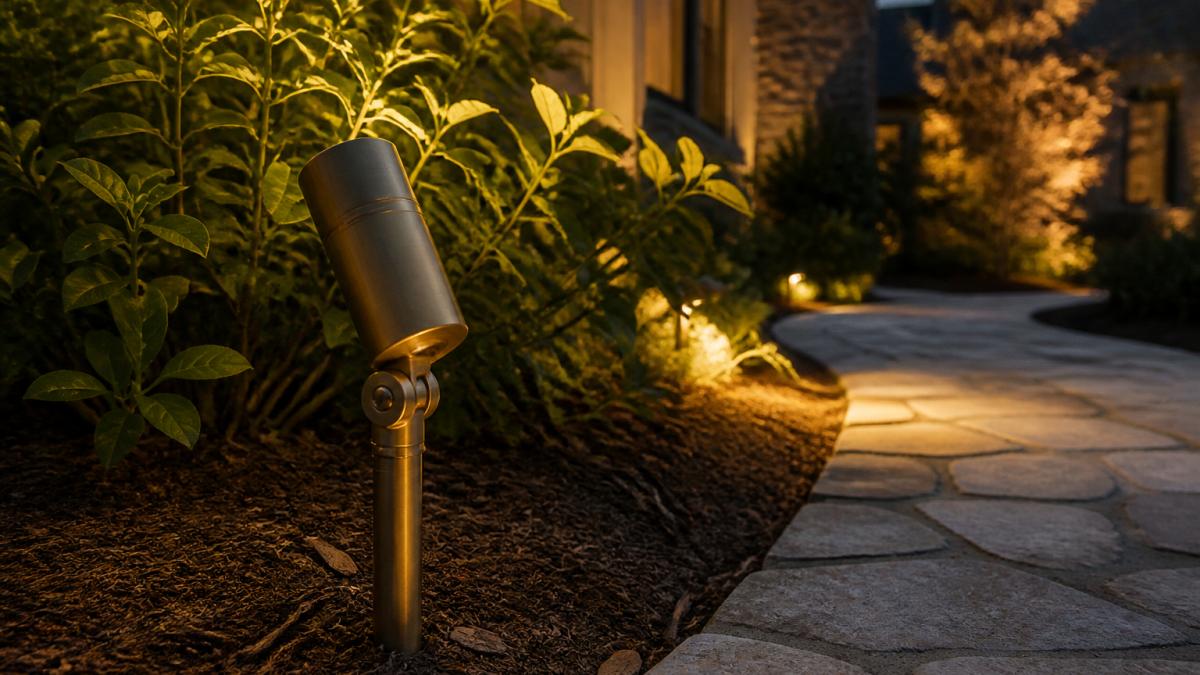
Brass and aluminum landscape lighting differ in one way that matters more than any spec sheet: what happens when water and oxygen reach the metal. Brass forms a protective surface layer as it ages. Aluminum does not.
Cheap aluminum fixtures are usually coated or painted to slow corrosion. That coating is the weak point.
Corrosion, Rust, and How Each Metal Handles Missouri Weather
Missouri weather is hard on outdoor metal. Summers bring heavy rain and humidity, and winters bring freeze-thaw cycles.
- Solid brass: oxidizes slowly and evenly, forming a stable surface that protects the metal beneath
- Aluminum: corrodes at seams and edges, especially where the coating chips
- Stainless steel: tough, but the wrong grade can still pit in coastal-style humidity
Here is how the common fixture materials handle water, oxygen, and Missouri weather.
| Material | How it handles moisture and weather |
|---|---|
| Solid brass | Oxidizes slowly and evenly, forming a stable protective surface |
| Aluminum | Corrodes at seams and edges, especially where coating chips |
| Stainless steel | Tough, but wrong grade can pit in coastal-style humidity |
| Plastic | Cracks under UV and temperature swings, then takes on water |
What Separates Solid Brass Outdoor Lighting Fixtures From Brass-Finished Ones
"Brass" on a box means very little. Solid brass outdoor lighting fixtures are cast or machined from brass through and through. Brass-finished fixtures are steel or aluminum with a thin brass-colored coating.
The difference shows up within a season or two:
- A scratch on solid brass dulls and blends in
- A scratch on brass-finished metal exposes the base metal, which then rusts
- Solid cast brass can be cleaned and re-aimed for years
- Coated fixtures start peeling at edges and joints
Ask one question before you buy: is the housing solid brass, or is it brass-colored? A supplier who cannot answer clearly is telling you something.
Brass Grades and Alloys: What the Spec Sheet Should Tell You
"Solid brass" is a starting point, not a guarantee of quality. Brass is a family of copper-zinc alloys, and the exact mix, along with how the housing is formed, determines how a fixture ages outdoors.
What to look for in product specifications:
- Copper content, brass with a higher copper share tends to weather more gracefully and develop a more even patina; very lean alloys can corrode less predictably
- Cast versus stamped, a cast housing holds wall thickness and seal geometry; a thin stamped shell is cheaper but flexes and admits moisture at seams
- Wall thickness and weight, a heavier housing is usually a thicker one; if a "brass" fixture feels light, ask why
- Sealing and gasketing, the lens seal and wire entry are where water gets in; quality brass fixtures use serviceable gaskets, not glue
Why Construction Quality Matters More Than the Word "Brass"
A solid brass housing is only as good as its weakest component.
- Wire connections, a brass housing with an unsealed connection still takes on water at the splice
- Lens and gasket, a degraded gasket lets moisture reach the LED and driver
- Mounting hardware, dissimilar metals in contact accelerate corrosion at the stake or bracket
That is why we specify fixtures built as a system: sealed connections, serviceable components, and hardware chosen to work together. Our USA-made fixtures carry a 20-year limited warranty.
How to Vet a Brass Fixture Before You Buy
A short checklist that separates real brass from marketing:
- Ask for the alloy and copper content in writing
- Confirm cast versus stamped construction
- Ask whether the LED module and lens are serviceable
- Look at the wire entry and gasket design
- Confirm the warranty covers the housing and what it excludes
- Ask whether replacement parts will be available years from now
A supplier who can answer all six is selling you a fixture built to last. One who cannot is selling you a finish.
Request a Lighting Consultation Today →
If you want to see how coverage is structured, read our guide to outdoor lighting warranty coverage.
Durability, Service Life, and the Case for Fewer Replacements
Durability is where brass earns its keep. A solid brass fixture with a sealed housing and quality wiring connections can serve a property for decades.
That gap changes the ownership math. You are not just buying metal.
Our fixtures carry a 20-year limited warranty. If you want to see how coverage is structured, read our guide to outdoor lighting warranty coverage.
Brass Landscape Lights Maintenance: What Owners Actually Do Each Year
A practical yearly routine:
- Rinse fixtures with a garden hose in spring to clear pollen and dirt
- Wipe the lens so light output stays bright
- Check that fixtures still point where they should after winter
- Look for water inside a housing and call for service if you find it
That is the whole list. No repainting, no recoating, no scraping rust. For a fuller seasonal checklist, see our landscape lighting maintenance tips.
Patina, Finish, and Whether Your Brass Will Change Color
Yes, brass changes color. Solid brass develops a patina, a soft darkening that many homeowners prefer to the shiny new look.
Some buyers want that aged bronze look from day one. Others want the fixture to stay closer to its original tone.
What patina is not: peeling, flaking, or rust. If a fixture is shedding a coating, that is a finish problem, not patina.
When Brass Is Not Worth the Premium
Brass is not always the right call. We say that plainly because a bad recommendation costs more than a lost sale.
Skip brass if:
- You are lighting a rental or a property you plan to sell within a couple of years
- The fixtures sit in a spot where they are likely to be damaged by equipment or vehicles
- Your budget is fixed and tight, and coverage matters more than material
- You want a small, simple setup where a shorter-lived fixture is genuinely fine
If that is your situation, our low voltage landscape lighting buyer's guide walks through the alternatives. And if you are still weighing materials, this breakdown of durable outdoor lighting fixtures compares how each one holds up.
For everyone else, brass landscape lighting is the choice that stops the replacement cycle.
Schedule a Nighttime Lighting Demonstration
The best way to judge brass is to see it after dark.
We offer a complimentary on-site consultation. Our Landscape Lighting Design & Installation service covers the whole system, and our Hardscape Lighting Design & Installation service extends that lighting to stone walls, steps, and patios.
We are licensed, bonded, and insured, and we are locally owned and operated.
Book a professional outdoor lighting consultation and see the difference for yourself.
Brass fixtures are not the cheapest way into landscape lighting, and we will never pretend otherwise. They are the version you stop thinking about, because nothing fails, nothing peels, and nothing needs replacing.
Frequently Asked Questions
Are brass landscape lighting fixtures worth the investment?
For most homeowners planning to stay in their property long term, yes. Solid brass landscape lighting costs more upfront than aluminum or plastic, but the metal resists corrosion, holds its finish far longer, and typically lasts decades rather than a handful of seasons. When you factor in fewer replacements, less labor, and the appearance of aged brass, the total cost of ownership often comes out ahead. The math shifts if you plan to move soon or have a very shaded, low-exposure site.
Is brass better than aluminum for outdoor lighting?
Brass and aluminum each have a place. Brass is denser, resists corrosion and rust, and develops a natural patina that many homeowners prefer. Aluminum is lighter and less expensive, but it depends on a factory coating for protection, and once that coating chips or peels, moisture reaches the metal. In humid, freeze-thaw, or coastal conditions, brass generally holds up longer. In a dry, sheltered spot with a tight budget, coated aluminum can still be a reasonable choice.
Do brass landscape lights tarnish or change color?
Yes, and that is part of the appeal. Unfinished solid brass outdoor lighting fixtures gradually shift from a bright gold tone to a deeper brown patina as they react with air and moisture. The change is even and protective, not a defect. Some homeowners prefer the aged look and let it develop; others polish the fixtures periodically to keep the original shine. Brass-finished aluminum does not patina, but it can flake or peel once the coating fails.
How do you maintain brass outdoor lighting fixtures?
Brass landscape lights maintenance is minimal. Wipe the fixture housings a few times a year with a soft cloth and mild soap to remove dirt and pollen, check that lenses and sealed housings are clear, and confirm wiring connections stay dry. If you want to slow patina, apply a brass polish occasionally. If you like the aged look, leave the metal alone.