 blog
Is Smart Home Integration for Outdoor Lighting Worth It in 2026?
Last Updated: November 1, 2026
Quick Summary
Smart home integration for outdoor lighting is worth it when the hardware underneath is planned correctly, since a controller only manages zones, schedules, and scenes built on proper fixtures, wiring, and transformer sizing. Choose whole-system controllers for new builds and smart switches or plugs for simple existing circuits.
- Whole-system controllers manage multiple zones and scenes but require a clean transformer setup and clearly separated zones.
- Plan roughly 20 to 25 percent headroom above the connected load when sizing a transformer.
- Confirm the controller exposes individual zones and runs schedules onboard when the internet drops.
- Mesh protocols like Zigbee or Thread generally handle a spread-out yard better than Wi-Fi.
- Use sunset offsets rather than fixed times so lighting comes on as ambient light fades.
Table of Contents
- Why Smart Home Integration for Outdoor Lighting Matters
- 7 Best Smart Home Integration Approaches for Outdoor Lighting Systems
- 1. Whole-System Smart Lighting Controllers
- 2. Smart Switches and Timers on Existing Circuits
- 3. Smart Plugs and Low-Voltage Transformers
- 4. Voice Control Through Major Home Assistants
- 5. Motion and Occupancy Sensor Integration
- 6. RGB and Color-Changing Accent Lighting
- 7. Scene-Based Automation and Scheduling
- How to Calculate Transformer Wattage for Landscape Lighting Layout
- Smart Landscape Lighting Automation Best Practices
- Compatibility, Safety, and Reliability in Real Outdoor Conditions
- Schedule a Nighttime Lighting Demonstration
- Frequently Asked Questions
Why Smart Home Integration for Outdoor Lighting Matters
Smart home integration for outdoor lighting connects exterior fixtures to a home automation system so they can be scheduled, controlled remotely, and coordinated with other devices.
But integration is only as good as the hardware behind it. A smart controller wired to weak fixtures and a poorly planned transformer will still produce uneven light, dark zones, and premature failures.
Below, we break down seven integration approaches, explain how to size a transformer correctly, and cover the compatibility and reliability questions most guides skip. For an overview of the design and installation work behind a smart-ready system, explore landscape lighting services.
7 Best Smart Home Integration Approaches for Outdoor Lighting Systems
The best approach depends on whether you are building a new system or adapting an existing one.
| Approach | Best For | Control Level | Works With Existing Wiring |
|---|---|---|---|
| Whole-system smart controller | New builds, full-property systems | Highest | No |
| Smart switches and timers | Simple on/off circuits | Basic | Yes |
| Smart plugs and low-voltage transformers | Plug-in transformers, DIY upgrades | Moderate | Yes, with limits |
| Voice control | Hands-free daily use | Add-on layer | Depends on hub |
| Motion and occupancy sensors | Security, path safety | Zone-based | Yes |
| RGB and color-changing accents | Seasonal and event lighting | High, per zone | Usually new fixtures |
| Scene-based automation | Multi-zone properties | Highest, when programmed well | Depends on controller |
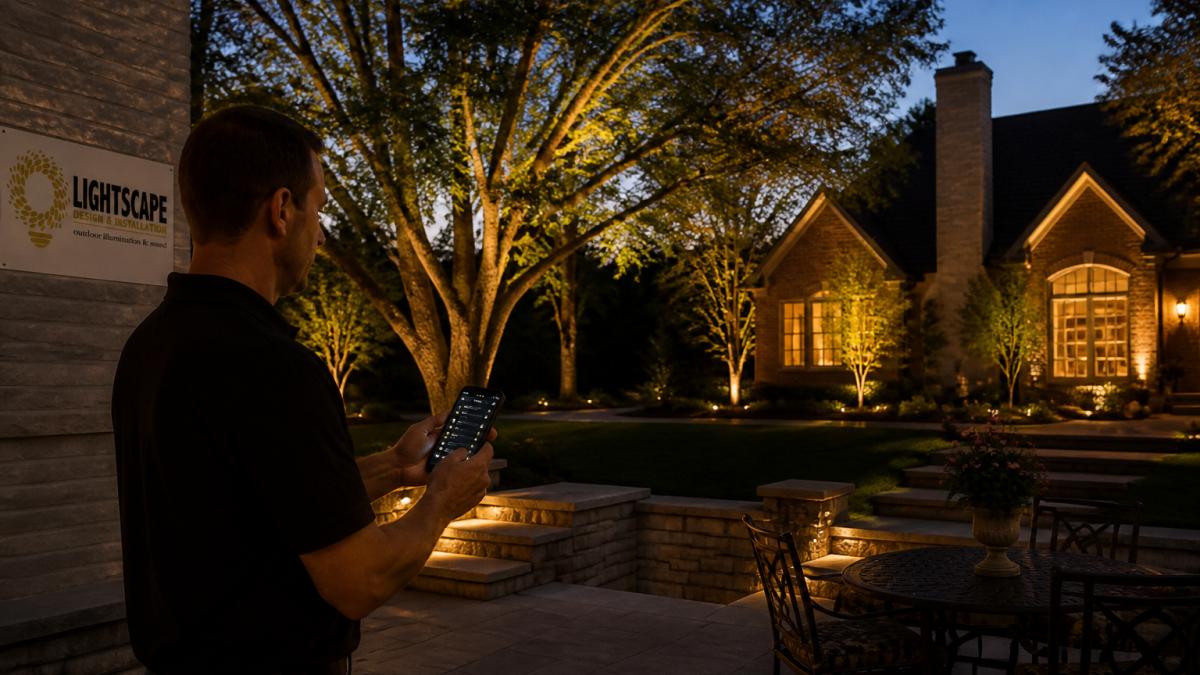
1. Whole-System Smart Lighting Controllers
A whole-system controller is the most capable option. It manages multiple lighting zones from one interface, stores schedules onboard, and holds scenes that change brightness across the property at once.
The trade-off is planning. Controllers need a clean transformer setup and clearly separated zones. Best for: homeowners building a full exterior lighting plan. Skip if: you have a single small circuit and no plans to expand.
2. Smart Switches and Timers on Existing Circuits
Swapping a standard switch for a smart switch is the least invasive route. It works well when an existing circuit already powers the lighting and you simply want scheduling and remote on/off.
The limitation is granularity. A smart switch controls the whole circuit, so every fixture on that run comes on at the same brightness.
3. Smart Plugs and Low-Voltage Transformers
Plug-in smart plugs suit low-voltage transformers that connect at an outlet. For a deeper look at fixtures, transformers, and wire gauge planning, see our best low voltage landscape lighting buyer's guide. They add scheduling and voice control without touching the wiring.
Best for: renters and small plug-in setups. Skip if: your transformer is hardwired or draws significant wattage.
4. Voice Control Through Major Home Assistants
Voice control is a layer, not a system. It works through a hub or controller that already supports the major assistants, letting you dim the patio lights or switch off the whole exterior from inside the house.
What most guides miss is that voice commands depend entirely on the platform underneath. If the controller does not expose individual zones to the assistant, voice control collapses into one blunt on/off command. Best for: households already using voice assistants daily. Skip if: your controller has no assistant support.
5. Motion and Occupancy Sensor Integration
Motion sensors turn lighting into a responsive system. Path and step lights can brighten when someone approaches, then return to a dimmer setting.
Placement is the hard part. Sensors aimed at a sidewalk will trigger on every passing car; sensors aimed too low miss visitors entirely. Best for: driveways, side yards, and entries. Skip if: your fixtures cannot be split into sensor-controlled zones.
6. RGB and Color-Changing Accent Lighting
Color-changing fixtures let you shift accent lighting for holidays, events, or a warmer tone in winter.
Honest limitation: color-changing light suits accent and landscape applications better than primary architectural lighting, where a steady warm white usually looks more refined. Best for: trees, garden beds, and hardscape accents. Skip if: you want a single classic look year-round.
7. Scene-Based Automation and Scheduling
Scenes are where integration pays off. A "dinner" scene dims the path lights, raises the patio, and warms the facade. An "away" scene runs a randomized schedule that makes the house look occupied.
The failure mode is over-automation: too many scenes nobody remembers to use. Best for: multi-zone properties with varied evening routines. Skip if: one schedule covers your needs.
How to Calculate Transformer Wattage for Landscape Lighting Layout
Transformer sizing involves three separate calculations that interact: load, headroom, and voltage drop.
Step 1: Total the load per run
List every fixture on a run and its wattage, then total it. Keep runs separate rather than summing the whole property, because each run has its own cable length and its own voltage drop. A 200-watt transformer feeding two 100-watt runs behaves very differently from one feeding a single 200-watt run.
Step 2: Add headroom
A transformer loaded to its maximum runs hot, shortens fixture life, and leaves no room for the additions most homeowners make within a year or two. A common practice is to plan for roughly 20 to 25 percent headroom above the connected load, and to size the transformer for the system you expect to have, not just the one you are installing today.
Request a Lighting Consultation Today →
Step 3: Check voltage drop over cable length
This is the step most DIY layouts skip. Low-voltage systems lose voltage over distance, and the loss depends on cable gauge, run length, and load. A fixture at the end of a long, heavily loaded run receives less than 12 volts, which shows up as dim output, color shift, and reduced LED life. The practical fixes are shorter runs, heavier cable gauge, or a transformer with multiple taps or a higher output voltage to compensate.
Step 4: Match the transformer to the control approach
If you plan to add a smart controller, confirm the transformer is compatible with it, some controllers require specific transformer types or a dedicated control lead. A transformer that cannot talk to your controller is a dead end no matter how well it is sized.
Custom wattages and beam spreads change this math, which is why we calculate per zone rather than per property. A tree uplight at a wide beam spread draws and delivers differently than a narrow path light, and the layout should reflect that.
If the numbers feel abstract, a professional layout can remove much of the guesswork.
Smart Landscape Lighting Automation Best Practices
Good smart landscape lighting automation follows a few rules that separate a system people love from one they mute.
- Layer the schedules. Keep a base schedule for security and add scenes for entertaining.
- Use sunset offsets, not fixed times. Lighting should come on as ambient light fades, not at an arbitrary hour.
- Keep manual overrides simple. If turning the lights off takes four taps, someone will unplug the transformer.
Routine care keeps automation reliable. Our landscape lighting maintenance tips cover cleaning fixtures, transformer care, troubleshooting, and seasonal prep.
Compatibility, Safety, and Reliability in Real Outdoor Conditions
Most integration plans fail in one of three places: the protocol layer, the electrical layer, or the weather layer.
Protocol compatibility: what "works with smart home" really means
A controller's compatibility claim is only as useful as the protocol underneath it. The four you will encounter in outdoor lighting are:
- Wi-Fi, no hub required, but range is the weak point outdoors. A controller in a metal transformer enclosure at the back of a lot may struggle to hold a signal, and Wi-Fi devices often consume more standby power than low-power mesh radios.
- Zigbee, mesh networking, strong for many fixtures spread across a yard, but requires a hub or bridge and is not natively supported by every major assistant ecosystem.
- Matter, the cross-vendor standard intended to make a controller work across Apple Home, Google Home, Amazon Alexa, and Samsung SmartThings without proprietary bridges (Build With Matter). Support varies by controller and by feature: a controller may expose on/off through Matter but not color or per-zone dimming.
Before buying, confirm four things in writing: which platforms the controller officially supports, whether it exposes individual zones (not just whole-system on/off), whether schedules run onboard when the internet drops, and whether firmware updates are delivered automatically. A controller that loses its schedule during an outage is a controller that leaves the property dark the one night it matters.
Electrical safety: low voltage vs. line voltage
Outdoor lighting splits into two worlds, and the safety rules differ.
- Line voltage (120V) runs from the panel to the transformer and, in some systems, to the fixtures themselves. This is licensed-electrician territory. It requires GFCI protection on outdoor circuits, weather-rated boxes and connections, proper grounding, and conduit where code requires it.
- Low voltage (typically 12V or 24V) runs from the transformer to the fixtures. It is far safer to work around, but it is not risk-free: transformers still connect to line voltage, connections must be rated for wet locations, and voltage drop over long cable runs causes dim fixtures and shortened LED life.
A common pattern we correct: a homeowner adds fixtures to an existing run without recalculating load, the transformer runs near its limit, and fixtures at the end of the run dim or flicker. The fix is zone planning and correct transformer sizing, not a bigger app.
Any work at the panel, the transformer's line-voltage side, or on a 120V circuit should be done by a licensed electrician. Low-voltage connections beyond the transformer still need wet-rated connectors, proper enclosures, and grounding per local code.
Reliability in real outdoor conditions
Fixtures and controllers face freeze-thaw cycles, summer storms, UV exposure, and constant moisture. To compare fixture materials and weather resistance before committing to smart controls, see our guide to durable outdoor lighting fixtures. Three specifications separate equipment built for it from equipment that merely survives a season:
- IP rating, the ingress protection code for dust and water. For exposed outdoor fixtures, look for ratings that explicitly cover water jets or temporary immersion depending on placement; connections and transformers need enclosures rated for wet locations.
- Operating temperature range, confirm the controller and fixtures are rated for the low and high extremes your climate produces, not just typical summer temperatures.
- Corrosion resistance, coastal and humid climates punish cheap housings. Marine-grade stainless, powder-coated aluminum, and quality gaskets hold up; untreated steel and thin plastics do not.
Wireless signal coverage is the fourth reliability factor most guides skip. A mesh protocol (Zigbee or Thread) generally handles a spread-out yard better than Wi-Fi because each powered device extends the network. If your controller is Wi-Fi-only, plan for a strong access point near the transformer enclosure or accept that the far zones may drop.
Our integrated LED fixtures are built without replaceable bulbs, with consistent color across zones and a 20-year limited fixture warranty.
Schedule a Nighttime Lighting Demonstration
Reading about scenes and sensors only goes so far.
A nighttime lighting demonstration lets you see how a property is lit after dark. You can also book a professional outdoor lighting consultation to learn what to expect and how to prepare.
A smart system is only as reliable as the design and installation beneath it, and that is the part worth getting right the first time.
Frequently Asked Questions
How do I integrate landscape lighting with my smart home system?
The integration path depends on how your fixtures are wired. A whole-system controller that replaces the low-voltage transformer gives you app, voice, and scheduling control over every zone. If your fixtures run on an existing circuit, a smart switch or timer can handle on/off and dimming without rewiring. For color-changing accent lighting, choose a controller that supports the same protocol as your hub, whether that is Wi-Fi, Zigbee, or Z-Wave. Confirm compatibility before buying, because a controller that speaks a different protocol than your hub will need a bridge or a return.
Can I control my outdoor lighting with voice commands?
Yes, provided the controller you choose works with a major voice assistant. Most whole-system smart lighting controllers and many smart switches pair with the leading voice platforms, so you can say a phrase to turn on path lights, dim the patio zone, or trigger a security scene. Voice control is best for quick overrides; scheduled routines handle the everyday on and off. Test the voice integration during setup, and keep a manual switch as a backup for guests and power outages.
Do smart outdoor lighting systems require professional installation?
Plug-in smart plugs and some retrofit switches are do-it-yourself friendly, but whole-system controllers, low-voltage transformer swaps, and anything tied to a 120-volt circuit are best handled by a licensed professional. Outdoor electrical work involves weatherproof connections, proper grounding, and code-compliant wiring that a homeowner may not get right. A professional installer also sizes the transformer correctly and aims fixtures so the lighting looks intentional rather than harsh. For a system you expect to last decades, professional installation is the safer path.
How does smart lighting improve home security and property value?
Smart lighting supports security by running consistent evening schedules, responding to motion sensors, and letting you check or adjust lights remotely when you are away. Layers of light along paths, entries, and dark corners also reduce trip hazards and make a property look occupied. On the value side, well-designed exterior lighting improves curb appeal and extends the usable hours of patios and outdoor living areas, which buyers notice. The gains come from thoughtful design and reliable hardware, not from the app alone.