 How-to
How Permanent Outdoor Lights Installation Works
Last Updated: November 19, 2026
Quick Summary
Professional permanent outdoor lights installation happens in three phases: planning, mounting, and connecting to a dedicated low-voltage power supply. A crew surveys your property after dark, marks fixture locations, buries cable runs, mounts fixtures on soffit, fascia, trees, or hardscape, then aims every light after dark. The system runs on a low-voltage transformer with waterproof connections and integrated LED fixtures.
- Installation follows seven steps, from nighttime consultation and trenching through aiming, adjustment, and a final walkthrough.
- Every fixture draws wattage, so each circuit must stay within the transformer's rated capacity to avoid dimming.
- A phone estimate without seeing the property is a guess, because fixture count and access cannot be judged from a description.
- Fixtures use integrated LED technology with no replaceable bulbs, and USA-made fixtures carry a 20-year limited fixture warranty.
- The common failure points after year three are waterproof connectors, transformer cooling and enclosure, and fixture lenses.
Table of Contents
- What Permanent Outdoor Lights Installation Actually Involves
- Planning Permanent Outdoor Lights for House Installation
- Step-by-Step: The Professional Installation Process
- What Drives Permanent Outdoor Lights Installation Cost
- Finding the Best Permanent Outdoor Lights Installation Near Me
- Permitting, HOA Rules, and Long-Term Maintenance
- Choosing Outdoor Lighting Installation Near Me: DIY or Professional
- Book a Nighttime Lighting Demonstration
- Frequently Asked Questions
What Permanent Outdoor Lights Installation Actually Involves
Permanent outdoor lights installation near me is the phrase most homeowners type when they want a system that stays on the house year-round, not a box of strands that comes down in January.
Permanent outdoor lights for house installation is a different discipline from hanging holiday lighting. The fixtures are built to live outside for decades. They use integrated LED technology with no bulbs to replace, and they connect to a low-voltage transformer instead of a wall outlet.
How Permanent Systems Differ From Seasonal Strands
Seasonal lighting is temporary by design. The clips, the adhesive, and the thin wire all assume the product comes down within a few months. Permanent systems assume the opposite.
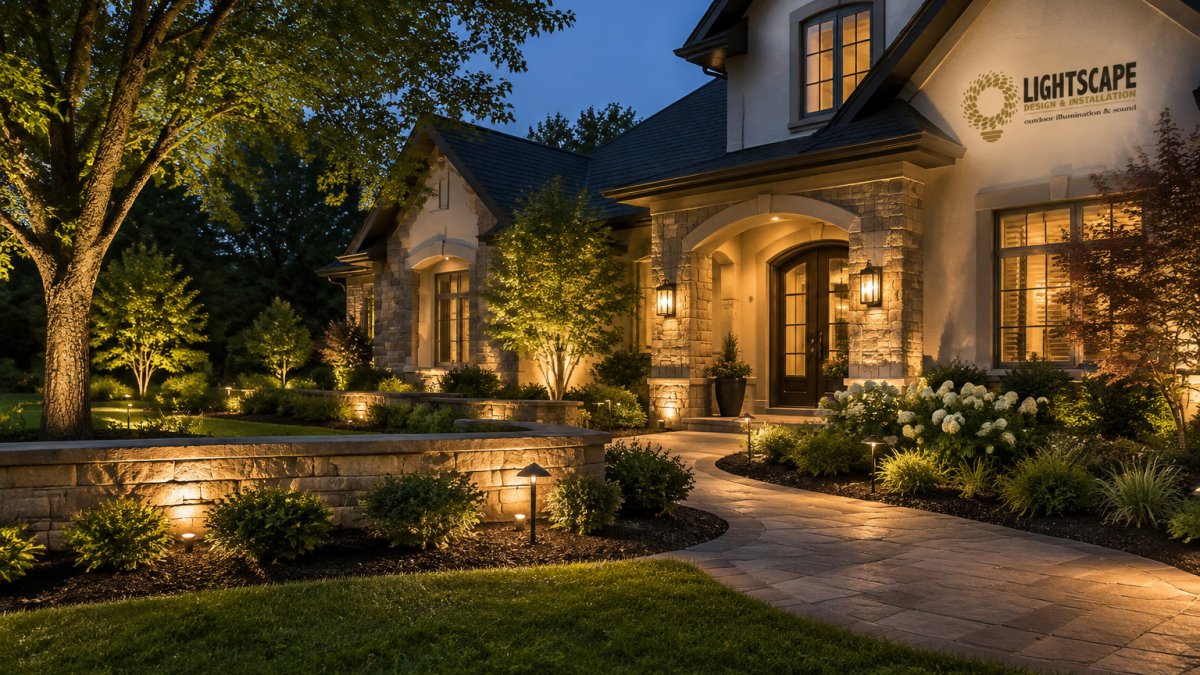
The payoff shows up in how the property looks. A seasonal strand throws one color along a straight line. A permanent system uses separate fixtures so tree canopies, stone walls, and rooflines each get the light they actually need.
Planning Permanent Outdoor Lights for House Installation
Good planning starts with a nighttime walk of the property, not a catalog. The survey looks at what deserves light, what should stay dark, and where glare would annoy a neighbor or a driver.
The plan also sets the color temperature. A single consistent light color across every fixture is what separates a designed system from a random collection of bright spots.
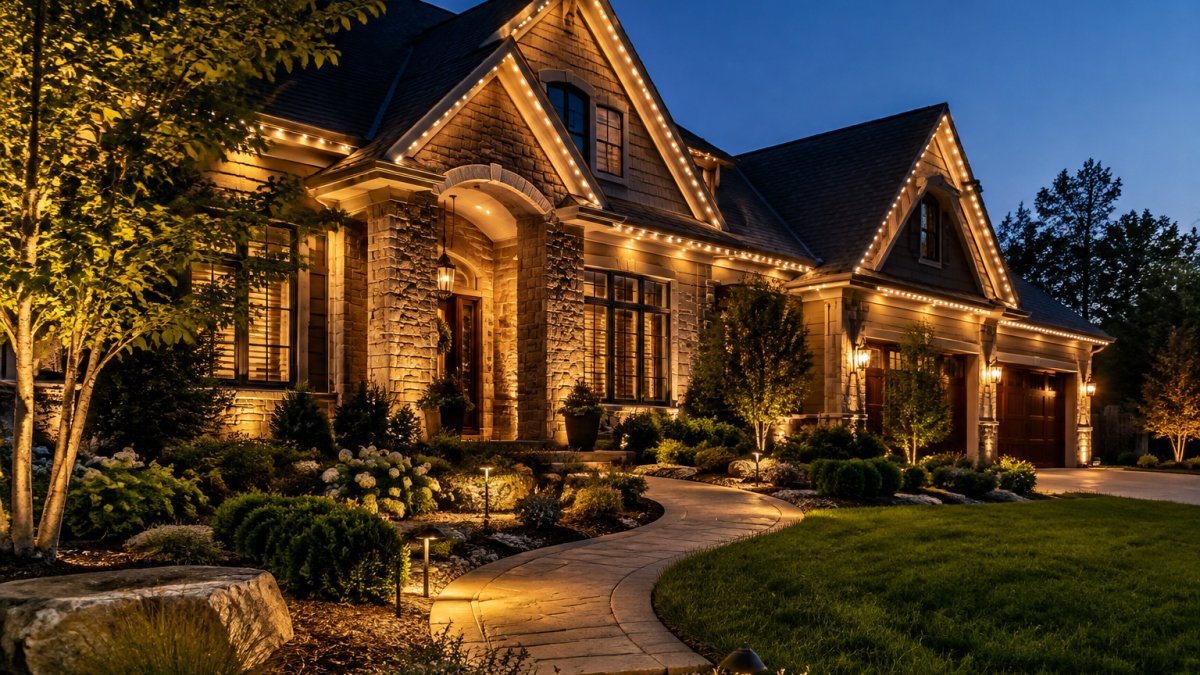
Mounting Surfaces: Soffit, Fascia, and Roofline
Each mounting surface changes the fixture and the hardware. Soffit installation hides the fixture body and throws light down a wall.
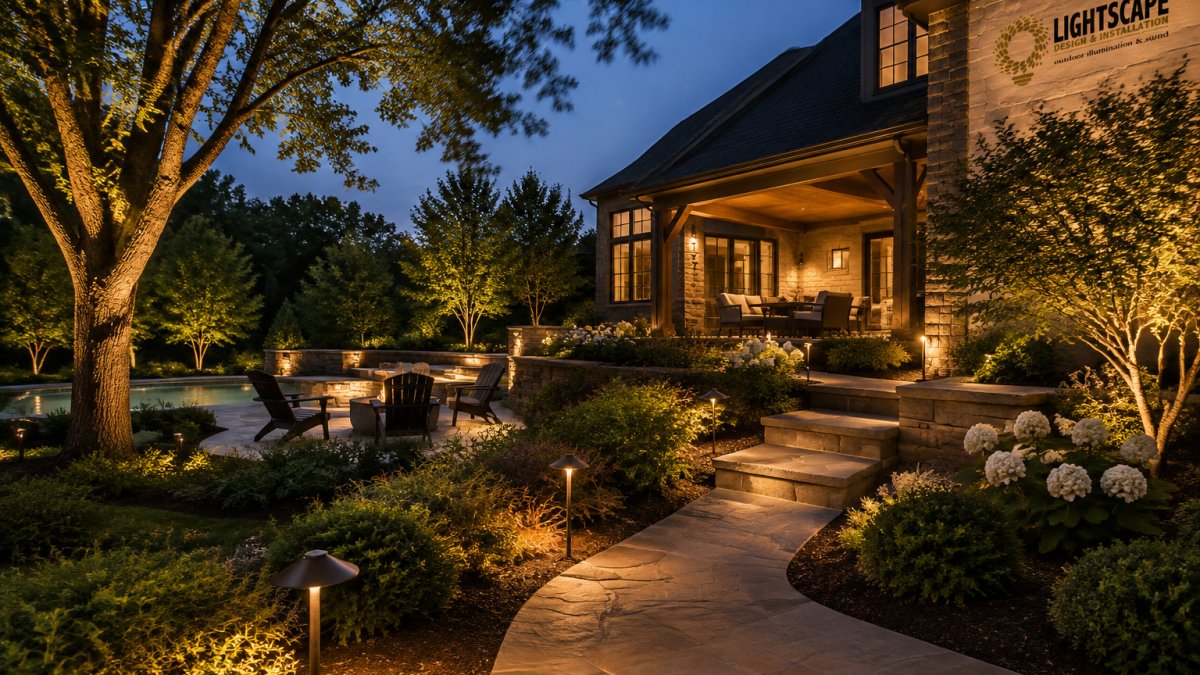
Hardscape and pathway lighting follow the same logic. Step lights, retaining wall lights, and path fixtures are placed to mark a walkable edge without lighting the whole yard.
Step-by-Step: The Professional Installation Process
Professional installation follows a fixed sequence, and the order matters as much as the parts.
- Nighttime consultation. We map the property after dark and mark fixture locations on site.
- Layout and trenching. Cable runs are planned along beds and walls, then buried at a shallow depth.
- Mounting. Fixtures go up on soffit, fascia, trees, or hardscape with the correct bracket for each surface.
- Wiring and connections. Waterproof connectors join each fixture to the home run.
- Transformer and controls. The power supply unit and timer settings are installed at the source.
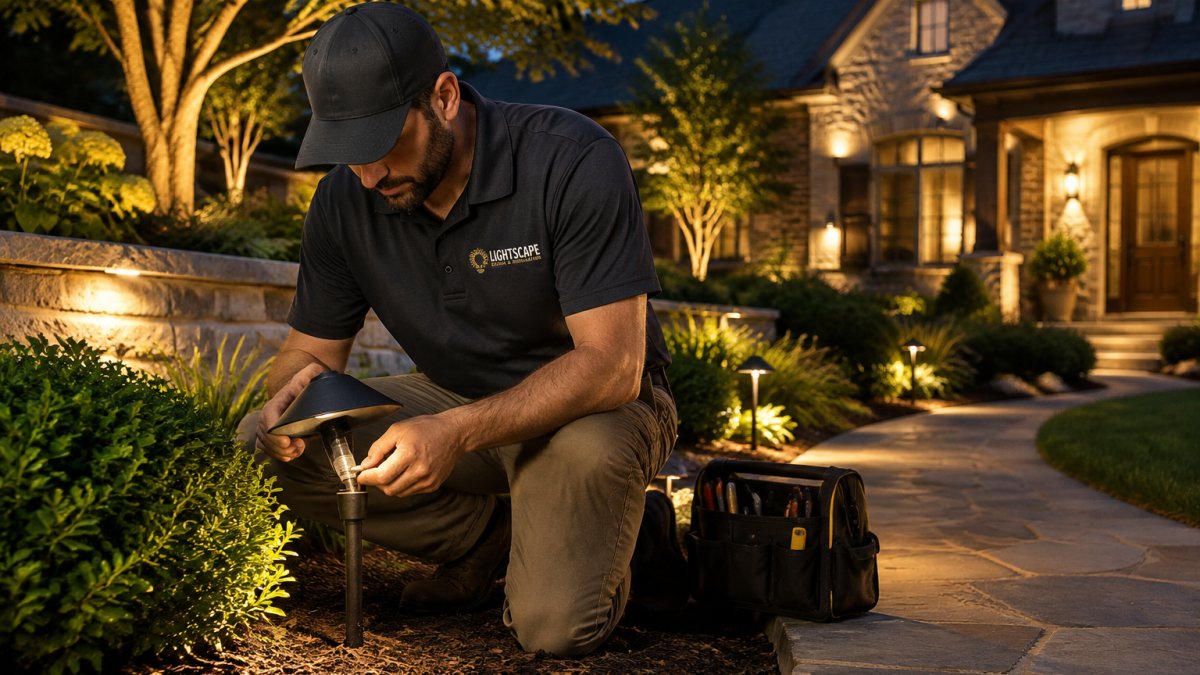
- Aiming and adjustment. Every fixture is aimed after dark, then re-aimed once the plants and trees fill in.
- Walkthrough. We hand over the system with the controls explained and the warranty registered.
Electrical Load and Circuit Safety
Low-voltage systems are safe to work around, but they are not forgiving of bad math.
Connections deserve equal attention. A waterproof splice done correctly lasts for years. One done with a twist and tape fails in the first wet season.
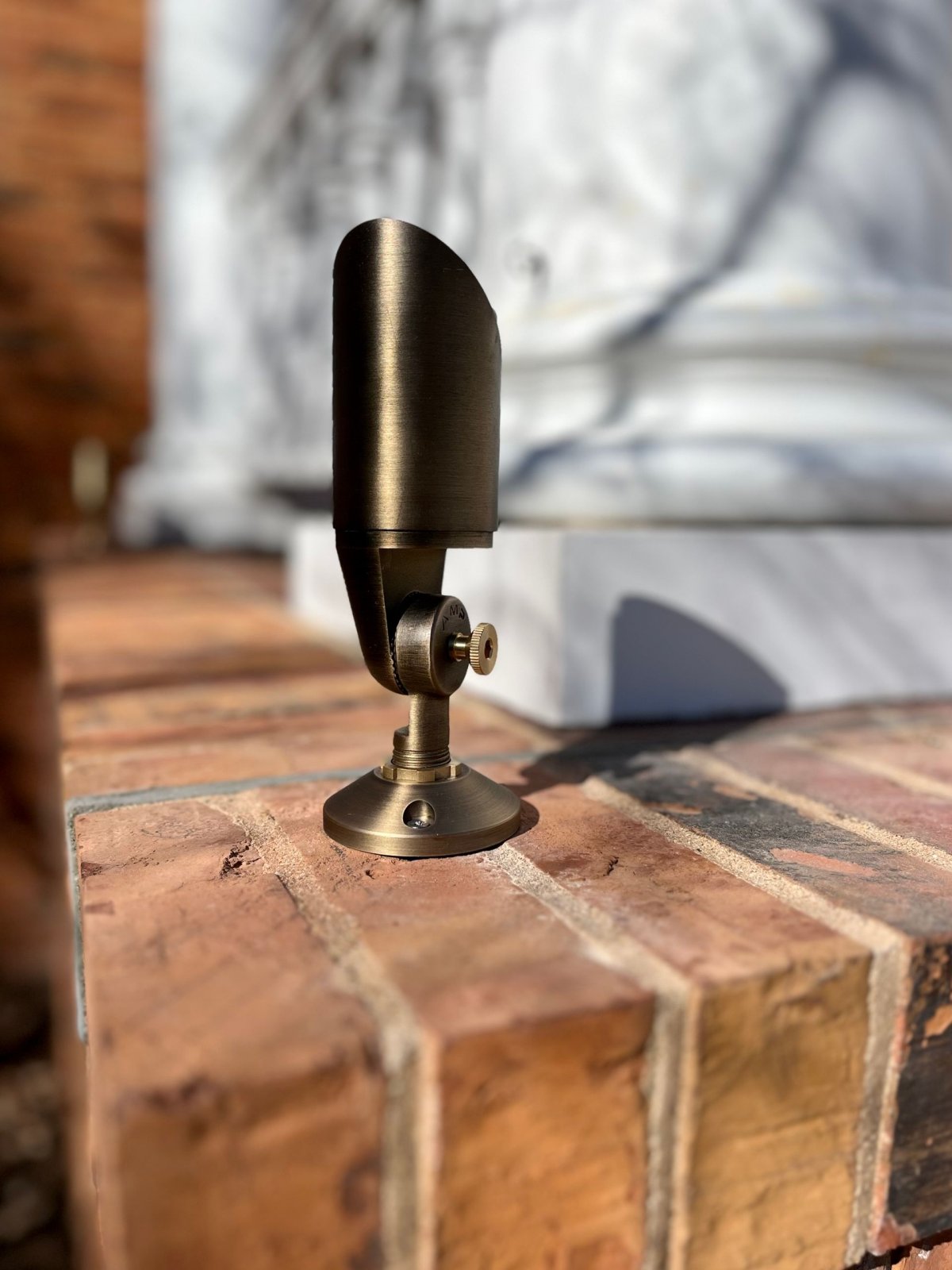
Professional installation follows a fixed sequence, and the order matters as much as the parts.
| Step | What to do |
|---|---|
| 1 | Nighttime consultation; map property after dark, mark fixture locations |
| 2 | Layout and trenching; plan cable runs, bury at shallow depth |
| 3 | Mounting; fixtures on soffit, fascia, trees, hardscape with correct bracket |
| 4 | Wiring and connections; waterproof connectors join fixture to home run |
| 5 | Transformer and controls; install power supply unit and timer settings |
| 6 | Aiming and adjustment; aim after dark, re-aim once plants fill in |
| 7 | Walkthrough; hand over system, explain controls, register warranty |
What Drives Permanent Outdoor Lights Installation Cost
Permanent outdoor lights installation cost is driven by scope and site conditions. Pricing depends on quantity, access, and design, and current pricing is available from a quote.
- Fixture count and fixture type. A path and a few tree uplights require fewer fixtures than a full architectural wrap of soffit, fascia, and roofline. Integrated LED fixtures with customized wattages and beam spreads cost more per unit than a generic wash fixture, but they let a designer put light only where it belongs instead of over-lighting to compensate.
- Property size and access. Long cable runs, steep grades, dense plantings, and fenced or gated areas all add labor. A run that crosses a driveway or a paver patio needs a different burial method than one that follows a planting bed.
- Mounting complexity. Soffit and fascia work is comparatively fast because the surfaces are uniform and reachable. Concealed runs through stone veneer, mature trees, or hardscape require more time, more hardware, and sometimes a different fixture body entirely.
Watch out: a phone estimate given without seeing the property is a guess, because fixture count and access cannot be judged from a description. Quotes are prepared after a nighttime walk of the property, when fixture locations, circuit layout, and transformer placement can be marked on site.
Why Electrical Load Changes the Number
Low-voltage systems are safe to work around, but they are not forgiving of bad math. Every fixture draws wattage, and the total on a circuit must stay within the transformer's rated capacity. Long cable runs also lose voltage, and a run that is too long will dim the fixtures at the far end. Splitting the property into multiple circuits solves both problems and keeps one failure from darkening the whole yard.
Why Mounting Surface Changes the Number
Brick, stucco, wood siding, and stone veneer each call for different anchors, different brackets, and different care. Brick and stone accept masonry anchors and can carry a heavier fixture, but drilling requires the right bit and patience to avoid spalling. Stucco needs anchors that reach the structural sheathing behind the finish, or the fixture will loosen as the stucco cracks.
For a fuller breakdown of what shapes a proposal, see our guide to the cost of professional outdoor lighting.
Finding the Best Permanent Outdoor Lights Installation Near Me
The best permanent outdoor lights installation near me searches return two kinds of results: national sellers who ship fixtures, and local crews who install them. Those are not the same product, and the difference shows up years later.
Ask three questions of any installer. Who aims the fixtures after dark? Who handles warranty service if a fixture fails? Our guide to choosing outdoor lighting companies near you walks through the vetting questions in detail.
U.S. Department of Energy guidance on outdoor lighting and energy use is a useful neutral reference for how low-voltage LED systems compare on efficiency.
Permitting, HOA Rules, and Long-Term Maintenance
Permit and HOA requirements vary by municipality and by subdivision, and the HOA question is often the one that actually delays a project. The checklist below is the one we walk through before installation, and it is worth confirming before any crew opens a box.
HOA and Permit Checklist
- Read the architectural guidelines, not just the covenants. Many HOAs regulate fixture visibility from the street, light spill toward neighbors, and whether wiring can cross a shared easement. Some require fixture color to match the home's trim.
- Confirm whether a permit is required for the transformer. Low-voltage systems often fall below the threshold, but the transformer's location and any line-voltage connection to the home's electrical panel may still need review.
- Check setback and easement rules. A fixture or cable run that crosses a utility easement can be removed by the utility, regardless of HOA approval.
Watch out: a fixture that is compliant on the day of installation can become non-compliant after a landscaping change or a new neighbor, so keep the approval paperwork with the system documentation.
What Actually Fails After Year Three
Maintenance is modest but real, and the failures that show up after a few years are predictable. Fixtures need occasional cleaning, plantings need trimming back off the lenses, and the transformer and connections deserve an annual look. The common failure points are the waterproof connectors, the transformer's cooling and enclosure, and the fixture lenses themselves, which can cloud or collect debris.
- Connector failure. A waterproof splice done correctly lasts for years. One done with a twist and tape fails in the first wet season, and the symptom is a single dark fixture or a flickering zone.
- Transformer stress. A transformer that is undersized for the load runs hot and shortens its own life. An annual look at the enclosure and connections catches this before it becomes a replacement.
- Lens and housing wear. Debris, pollen, and trimming damage cloud a lens and change the beam pattern. Cleaning restores most of it; a cracked lens is a fixture service item.
When to Call a Pro
A single dark fixture is usually a connector or a failed fixture, and a pro can diagnose it quickly. Our landscape lighting maintenance tips cover the seasonal checklist in more detail.
Because the fixtures use integrated LED technology with no replaceable bulbs, there is no bulb to change on a schedule, the service items are connections, lenses, and the transformer.
Choosing Outdoor Lighting Installation Near Me: DIY or Professional
DIY kits appeal on price, and for a small path or a single tree, a homeowner can get a decent result. The limits appear at scale.
Professional installation brings design judgment, proper hardware, and warranty coverage that lasts. If you want to see the full scope of what a designed system includes, review our landscape lighting services.
NFPA 70 National Electrical Code information is the reference most jurisdictions adopt for electrical work, which is why low-voltage connections and transformer placement follow established practice.
Book a Nighttime Lighting Demonstration
The fastest way to judge a lighting design is to see one after dark. You can schedule a professional outdoor lighting consultation and see the difference before committing.
A property that disappears at sunset is leaving value on the table. Lightscape Design & Installation designs and installs USA-made fixtures with integrated LED technology, backs them with a 20-year limited fixture warranty, and aims every fixture after dark so the result looks intentional.
Frequently Asked Questions
How long does permanent outdoor light installation take?
Most single-family homes take one to three days depending on roofline length, mounting surface, and how many circuits are needed. A straightforward soffit run on a ranch home can finish in a day, while larger two-story homes with multiple zones and hardscape lighting take longer. Planning and nighttime aiming add time up front but prevent callbacks. Ask your installer for a written schedule before work begins.
Can permanent outdoor lights be installed on any home?
Most homes can support permanent outdoor lights, but the mounting surface matters. Vinyl and wood soffits, fascia boards, and masonry all accept fixtures with the right hardware. Older homes sometimes need a dedicated circuit or a low-voltage transformer sized to the run. A site visit confirms what your eaves, roofline, and panel can handle before anyone quotes a plan.
What are the downsides of permanent lights?
The main drawbacks are upfront cost compared with seasonal strands and the need for a properly sized transformer and wiring. Poorly aimed fixtures can create glare or light trespass that bothers neighbors. Cheap fixtures with replaceable bulbs fail sooner and drift in color over time. Integrated LED fixtures from a reputable installer avoid most of these issues and carry warranty coverage.
What should I ask an outdoor lighting installer before hiring?
Ask for proof of licensing, bonding, and insurance, and confirm who handles warranty work years from now. Request a nighttime demonstration so you see the actual effect before committing. Ask whether fixtures are USA-made, whether LED modules are integrated or replaceable, and how long the warranty runs. Also confirm they handle permitting and HOA paperwork where required.