 How-to
Why Warm White Light Belongs in Every Garden Lighting Plan
Last Updated: November 12, 2026
Quick Summary
Warm white light, rated between 2200K and 3000K, casts a soft amber glow that flatters brick, stone, bark, and foliage while cool white washes those surfaces out. It also emits less blue light, so it generally attracts fewer insects around patios and pools. Keeping every fixture on one warm color temperature helps the whole garden read as a single system.
- Warm white light is typically rated 2200K to 3000K; cool white is 4000K and above.
- Kelvin measures color tone, not brightness, which is measured in lumens.
- Aim tree uplights slightly off the trunk so light rakes the bark instead of creating a hot spot.
- Shielding, aiming, and dimming solve most glare problems in a garden lighting plan.
- Wet stone and brick reflect more light, so fixtures read brighter after rain.
Table of Contents
- Warm White vs. Cool White Outdoor Lighting: The Difference You See First
- What 2700K Landscape Lighting Does for Foliage, Flowers, and Facades
- The Best Outdoor Light Color to Avoid Bugs Around Patios and Pools
- Tree Uplighting in Warm White: Making Mature Oaks and Maples Look Their Best
- Brightness Is Not Color: Measuring Lumens, Beam Angle, and Glare Control
- A Zone-by-Zone Garden Lighting Plan for Warm White Fixtures
- Schedule a Complimentary Nighttime Lighting Demonstration
- Frequently Asked Questions
Warm White vs. Cool White Outdoor Lighting: The Difference You See First
Walk outside after dark and the color of your garden lighting hits you before anything else. Warm white light, typically rated between 2200K and 3000K on the Kelvin scale, casts a soft amber glow that mimics candlelight and sunset. Cool white light, usually 4000K and above, reads as crisp, blue-tinted, and clinical.
Warm white light flatters brick, stone, bark, and foliage, while cool white tends to wash those same surfaces out.
The Kelvin rating is simply a measure of color tone, not brightness. A 2700K landscape lighting fixture and a 4000K fixture can put out identical lumens and look completely different. One feels like a lantern. The other feels like a parking garage.
Most homeowners notice three things right away when they compare the two side by side:
- Warm white makes wood, brick, and stone look richer
- Cool white pushes plants toward a gray, flat appearance
- Warm white blends with interior window light instead of fighting it
If your home's windows glow warm from inside, cool white garden lighting creates a visible clash at the facade. Warm white ties the whole scene together.
What 2700K Landscape Lighting Does for Foliage, Flowers, and Facades
Color temperature changes how plants read at night. Under 2700K landscape lighting, green foliage keeps its depth instead of turning pale. Red and orange flowers hold their warmth. Brick and stone pick up a golden tone that matches their daytime appearance.
Cool white light does the opposite. It strips the red tones out of brick and makes mulch look gray. On evergreens, it can create an icy cast that feels out of place in a garden.
Here's what we watch for on a design walk:
- Foliage: Warm white keeps leaves looking green and layered
- Flowers: Reds, oranges, and yellows stay saturated under warmer tones
- Facades: Brick, stone, and stucco gain depth rather than glare
Mixing color temperatures across one property can create a patchwork look. Keeping every fixture on a single color temperature helps the whole garden read as one system.
The Best Outdoor Light Color to Avoid Bugs Around Patios and Pools
The best outdoor light color to avoid bugs is warm white, and the reason comes down to how insects see light. Many flying insects are drawn to short-wavelength blue and ultraviolet light. Cool white LEDs emit more blue light, which pulls moths, midges, and other insects toward the source.
Warm white fixtures emit less blue light and generally attract fewer insects, though they still draw some. That matters most around patios, pools, and outdoor kitchens where people gather after dark.
Placement does as much work as color. A few habits cut insect activity around seating areas:
- Aim fixtures away from doorways and seating zones
- Use shielded fixtures so light lands on the ground, not into the air
- Keep bright light off the pool surface where insects gather
- Put path lighting low and pointed down
For pool areas, the fixture itself matters too. Low-voltage, waterproof housings with sealed connections hold up to splash and weather, and glare-free placement keeps swimmers comfortable. Our guide on landscape lighting for pools covers fixture selection and placement in more depth.
Tree Uplighting in Warm White: Making Mature Oaks and Maples Look Their Best
A mature oak or maple is the best argument for warm white light in a garden. Uplighting a large tree shows off bark texture and branch structure that disappears in daylight. Warm white brings out the ridges and color in the trunk instead of flattening it.
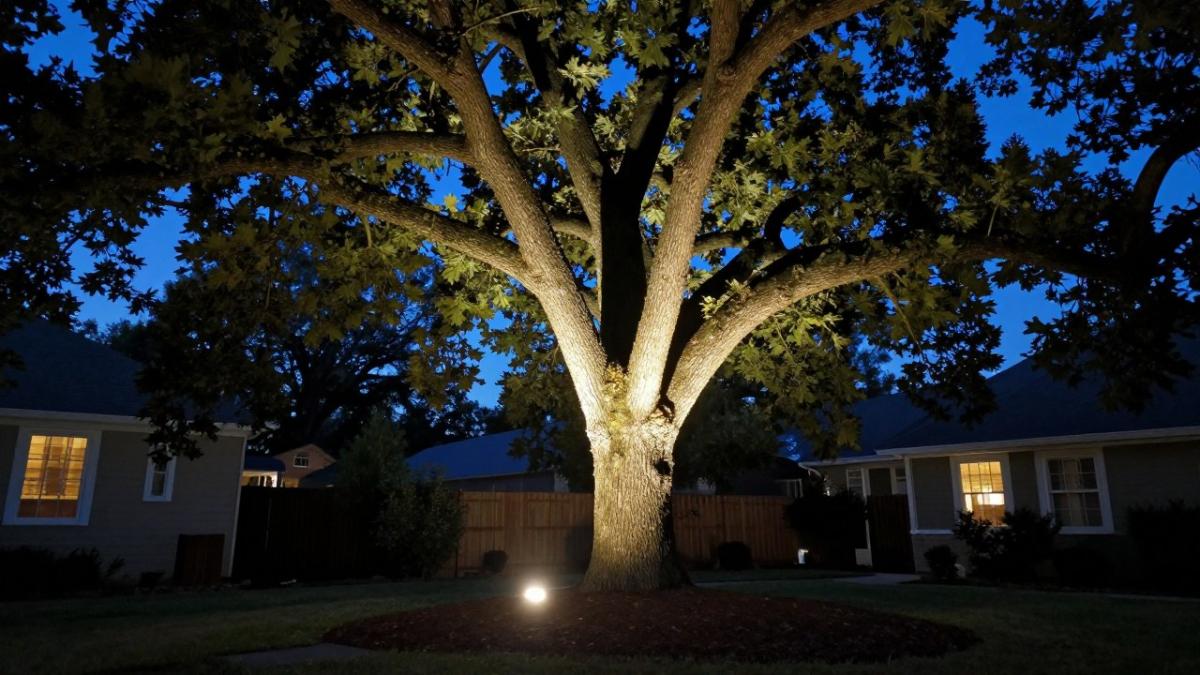
The technical choices behind good tree lighting are beam angle, lumen output, and color temperature. A narrow beam throws light high into the canopy. A wider beam washes the trunk. Warm white at 2700K keeps the effect natural.
Aiming matters in tree lighting. A fixture pointed straight up the trunk can create a hot spot, while angling it slightly off the trunk lets light rake across the bark.
For a full breakdown of beam angles and output for different tree sizes, see our guide on the best landscape lighting for trees.
Brightness Is Not Color: Measuring Lumens, Beam Angle, and Glare Control
Brightness and color temperature are two separate measurements, and confusing them is the most common design error we see. Brightness is measured in lumens (Energy 101: Lumens). Color is measured in Kelvin. A fixture can be dim and cool, or bright and warm.
That distinction matters because most over-lit gardens are not a color problem. They are a brightness problem. A warm white fixture run at too high an output still looks harsh, and a cool white fixture run low can still feel clinical. Color and brightness have to be tuned together.
Here is the practical framework we use:
- Start with the task. Paths and steps need enough light to see footing, not enough to read a book. Accent and tree lighting need enough output to reach the canopy or wall surface, which is a function of beam angle as much as lumens.
- Match beam angle to distance. A narrow beam throws light farther; a wide beam spreads it over a larger surface. A narrow beam at high output creates a hot spot, while a wide beam at low output can leave a wall flat.
- Tune output per zone. Customized wattages and beam spreads can be set for each zone so paths, beds, and facades are not all running at the same level.
- Dim rather than overshoot. A fixture that is slightly too bright at full output can be dimmed to the right level; one that is too dim cannot be fixed without replacing it.
Glare is the third piece. A bright fixture aimed at eye level creates glare even at a warm color temperature. That harsh, artificial look many homeowners worry about comes from glare and over-lighting, not from color.
Three fixes solve most glare problems:
- Shielding: a shielded fixture hides the source and directs light where it belongs
- Aiming: point fixtures at surfaces, not at sightlines
- Dimming: lower output and integrated LED drivers let us tune each zone
Watch out: adding more fixtures is often the wrong fix for a dark garden. A single well-aimed fixture at the right output usually reads better than three fixtures competing for the same surface.
Light pollution belongs in this conversation too. Light that spills upward or off the property wastes energy and washes out the night sky. Shielded, downward-aimed fixtures keep light where it was intended.
Our guide on avoiding harsh outdoor lighting glare walks through shielding and aiming in detail.
A Zone-by-Zone Garden Lighting Plan for Warm White Fixtures
A garden lit as one flat wash looks dull. A garden lit in layers looks designed. We plan in zones, and warm white ties them together.
| Zone | Fixture Type | Warm White Setting | Aiming and Shielding | What It Achieves |
|---|---|---|---|---|
| Paths and steps | Low path lights | 2700K, low lumens | Point down and slightly across the walk; shield the source from eye level | Safe footing, soft pools of light |
| Garden beds | Accent uplights | 2700K, narrow beam | Set back from the plant and angle across foliage, not straight up the stem | Depth and drama among plants |
| Trees | Uplights | 2700K, medium beam | Offset from the trunk so light rakes the bark; avoid a hot spot at the base | Bark texture and canopy glow |
| Facade | Wall wash or uplight | 2700K, shielded | Aim at the wall surface, not up into the eaves; keep the source hidden | Architectural depth |
| Hardscape | Recessed or step lights | 2700K, dimmed | Flush-mount so the lens sits below the tread; direct light onto the surface | Safety and clean lines |
| Patio and pool | Shielded area lights | 2700K, low glare | Aim away from seating and doorways; keep light off the water surface | Comfort after dark |
Here is how we turn that table into a working plan, zone by zone.
Paths and steps. Start with the walking route, not the plants.
Garden beds. Accent uplights in beds should be set back from the plant and angled across the foliage so leaves catch light at an angle.
Trees. Tree uplighting is where aiming matters most. A fixture pointed straight up the trunk creates a bright band and leaves the canopy dark.
Hardscape. Recessed and step lights work best flush-mounted so the lens sits below the tread and light lands on the surface.
Patio and pool. Shielded area lights should aim away from seating and doorways, and light should stay off the pool surface where insects gather.
Season and weather change the look too. Wet stone and brick reflect more light, so the same fixture reads brighter after rain.
Our fixtures are USA-made with integrated LED technology and no bulbs to replace, and they carry a 20-year limited fixture warranty.
For more on layering beds specifically, our article on layering light in garden beds goes deeper.
Schedule a Complimentary Nighttime Lighting Demonstration
Color temperature is hard to judge from a catalog. A nighttime demonstration shows you exactly how warm white light lands on your trees, paths, and facade before you commit.
A complimentary nighttime lighting demonstration lets you see how warm white light lands on your property before you commit.
Our local team manages every step of the process, and our team is licensed, bonded, and insured. Every fixture carries a 20-year limited fixture warranty.
Your garden already has the structure and plantings worth showing off after dark. The right color temperature is what reveals them. Lightscape Design & Installation designs and installs warm white lighting systems across the St. Louis area, using USA-made fixtures and integrated LED technology built to last. Get started with Lightscape Design & Installation and see your property in its best light after sunset. Book a professional outdoor lighting consultation to schedule your complimentary demonstration.
Frequently Asked Questions
Should garden lights be warm white or cool white?
For most residential gardens, warm white is the better choice. Warm white light in the 2200K to 3000K range flatters foliage, flowers, and natural stone, and it creates the cozy glow people expect from a garden after dark. Cool white light, closer to 4000K and above, reads as clinical and can wash out plant color. The main exception is a work area or security zone where maximum visibility matters more than atmosphere.
Does warm white light attract fewer bugs than cool white light?
Many flying insects are drawn to short-wavelength blue light, which is more present in cool white LEDs. Warm white light at 2700K and below contains less of that blue peak, so it tends to draw fewer insects around patios and pools. It is not a no-bug guarantee. Pairing warm white with shielded fixtures that aim light downward keeps spill and insect attraction lower still.
What color temperature is best for landscape lighting?
Most landscape lighting designs land between 2200K and 3000K. The 2200K range gives a candle-like amber tone that suits rustic stone and wood. Around 2700K, the sweet spot for many gardens, foliage looks green and facades look warm without turning orange. 3000K works when you want slightly crisper definition on architectural details. Keeping one consistent color temperature across the whole system matters as much as the number itself.
Does warm white light help plants grow?
Garden lighting is not a grow light, and its purpose is appearance and safety, not plant growth. Warm white LEDs do emit some red and blue wavelengths that plants use, but the levels and run times of decorative lighting are far below what growth requires. Choose warm white for how it makes the garden look at night, and leave plant health to sunlight, water, and soil.