 How-to
Outdoor Lighting Repair Near Me: What to Do First?
Last Updated: November 5, 2026
Quick Summary
For outdoor lighting repair, first locate the transformer and confirm the system is powered, then match the symptom to its likely cause before touching any wire. Check the timer, photocell, and connections, and reset a tripped transformer breaker only once. If the fault is buried, repeats, or shows heat damage, call a licensed professional.
- Gather a low-voltage voltage tester, flashlight, gloves, screwdriver, and notepad before heading outside.
- If every fixture is dark, check the transformer, timer, and photocell before anything else.
- Swap a suspect fixture with a known-working one to isolate a single dark fixture fast.
- Never splice buried cable with tape and a twist; call a licensed technician for buried faults.
- Clean lenses, trim vegetation, and check connections after storms to prevent repeat repairs.
Table of Contents
- Outdoor Lighting Repair Near Me: Start With These Safe Checks
- Low-Voltage Landscape Lighting Troubleshooting, Symptom by Symptom
- Outdoor Lighting Transformer Problems: How to Tell If Yours Is Failing
- Landscape Lighting Wiring Repair: What Homeowners Can and Can't Fix
- Outdoor Lighting Maintenance That Prevents Repeat Repairs
- Repair or Replace? Deciding What Your System Needs
- When to Call a Local Professional for Outdoor Lighting Repair
- Book a Nighttime Lighting Assessment
- Frequently Asked Questions
Outdoor Lighting Repair Near Me: Start With These Safe Checks
When outdoor lighting repair near me searches spike, it's usually because a path light has gone dark or a whole zone has quit at once. At Lightscape Design & Installation, we walk St. Louis homeowners through safe checks before anyone touches a wire.
Before you do anything, locate the transformer and confirm the system is actually powered. The National Electrical Code treats low-voltage landscape systems as Class 2 circuits, which is why they run on safer voltages than household wiring, but that does not make every component risk-free. NFPA overview of the National Electrical Code explains how those circuits are classified.
Below, we'll show you exactly how to diagnose the problem, what you can safely fix yourself, and when to call a local technician. Keep reading because the symptom-by-symptom flow saves most homeowners a service visit.
What You'll Need Before You Begin
Gather a few basics before you head outside: a voltage tester rated for low-voltage circuits, a flashlight or headlamp, work gloves, a screwdriver, and a notepad to track which fixtures are out. Note the transformer's location and whether it has a timer or photocell. If you're not comfortable working near buried cable, stop here and book a professional.
Low-Voltage Landscape Lighting Troubleshooting, Symptom by Symptom
Low-voltage landscape lighting troubleshooting starts with matching the symptom to the likely cause. A dead zone points to a power or wiring fault, while flickering points to a loose connection or water intrusion. Work through the symptoms below in order, and never dig into buried cable without shutting off the transformer first.
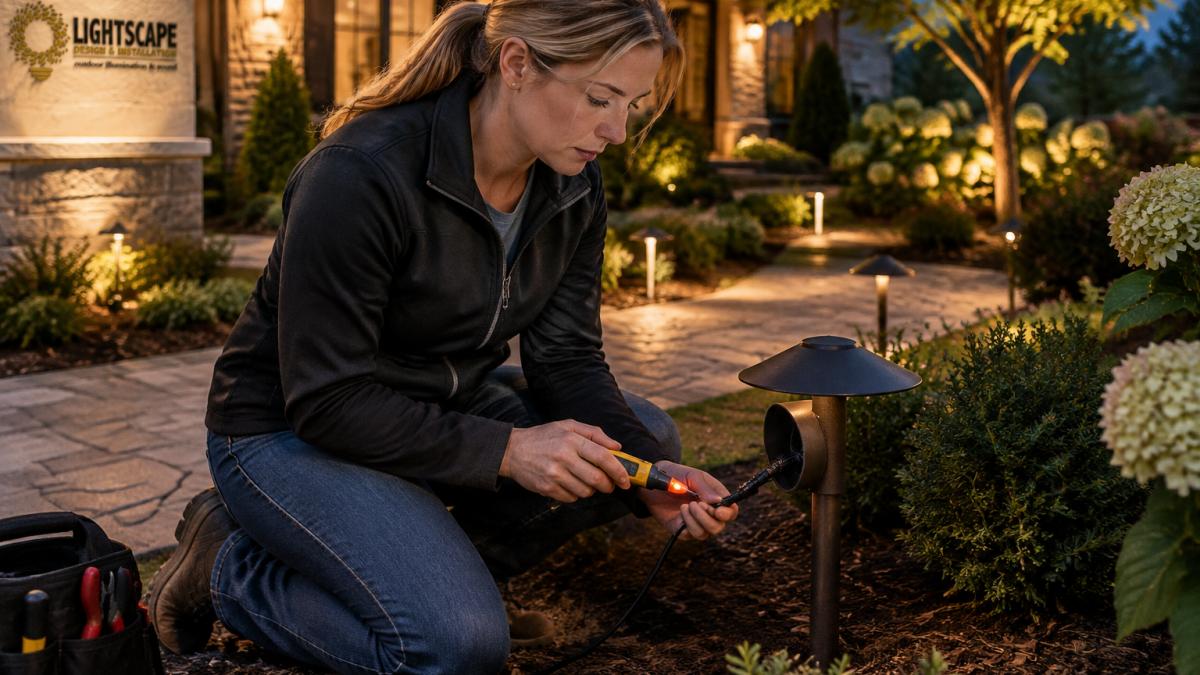
Lights Completely Out
If every fixture on the system is dark, check the transformer first: confirm it's plugged in, the timer hasn't tripped, and the photocell isn't covered by debris or shade. If a single zone is out, the fault is usually in the cable run feeding that zone. A tripped breaker inside the transformer is a common cause, and resetting it once is fine. If it trips again, stop and call a professional.
Flickering, Dim, or Partially Lit Fixtures
Flickering or dim fixtures usually mean a loose connection, corrosion at a splice, or water getting into a fixture housing. Check the connections at the transformer and at each fixture, and look for green corrosion on the terminals. Dimming across a whole run often signals voltage drop from cable that's too long or too thin for the load.
Lights Staying On During the Day
Lights that stay on past sunrise point to the photocell or the timer, not the fixtures. Confirm the photocell eye is clean and not shaded by foliage, then check whether the timer has lost its program after a power interruption.
One Fixture Dark While the Rest Work
A single dark fixture is the easiest fault to isolate. Swap the suspect fixture with a known-working one on the same run. If the problem moves with the fixture, the fixture is bad; if it stays with the location, the fault is in that fixture's connection or the cable stub feeding it. This swap test takes a few minutes and saves most homeowners a service call.
Watch out: never probe a connection with the transformer energized and your hands wet, and never assume a low-voltage system is harmless. A damaged transformer or a crossed line-voltage feed can still create a shock hazard near wet ground.
Match the symptom you're seeing to the likely cause before you head outside.
| Symptom | Likely cause | What to do |
|---|---|---|
| Every fixture dark | Transformer power, timer, or photocell | Confirm plugged in, timer not tripped, photocell clear |
| Single zone out | Fault in the cable run feeding that zone | Check the zone's cable run |
| Breaker trips inside transformer | Common cause of a dead zone | Reset once; if it trips again, call a professional |
| Flickering or dim fixtures | Loose connection, corrosion at splice, water in housing | Check connections at transformer and each fixture |
| Dimming across a whole run | Voltage drop from cable too long or too thin | Note the run and consult a professional |
| Lights on during the day | Photocell or timer, not the fixtures | Clean photocell eye, check timer program |
| One fixture dark, rest work | Bad fixture or bad connection at that location | Swap with a known-working fixture on the same run |
Outdoor Lighting Transformer Problems: How to Tell If Yours Is Failing
Outdoor lighting transformer problems show up as repeated breaker trips, a humming unit, a hot housing, or lights that dim when more fixtures turn on. The transformer is the power supply for the entire system, so a failing unit affects every fixture downstream. Test the output with a voltage tester and compare it to the rating on the label.
If the transformer is undersized for the load, it will run hot and fail early. That's one reason we size every system with headroom for future fixtures. If your transformer is on its way out and you're weighing a full upgrade, our low voltage landscape lighting buyer's guide covers fixtures, transformers, and wire gauge.
Landscape Lighting Wiring Repair: What Homeowners Can and Can't Fix
Landscape lighting wiring repair splits into two categories: connections you can safely re-seat and buried cable faults that need a professional. You can tighten a loose terminal, replace a corroded splice connector, and reseat a fixture that's worked loose from its stake. You should not splice buried cable, dig up a run without locating it first, or work on anything that shows signs of heat damage.
Watch out: never repair a cable that's been nicked by a shovel or edger with tape and a twist. That splice will corrode and fail, and it can create a shock hazard near wet ground. Call a licensed technician for any buried fault.
Request a Lighting Consultation Today →
What a Buried-Cable Fault Actually Looks Like
Most buried-cable faults are not dramatic. They show up as a zone that dims when the soil is wet, a run that works in dry weather and fails after rain, or a fixture that flickers only when the irrigation cycle runs. The mechanism is usually water intrusion at a splice or a nick in the jacket that lets moisture reach the conductor. Once copper corrodes, resistance climbs, voltage drops at the far end of the run, and the fixtures nearest the fault may look fine while the ones beyond it dim or go dark.
Locating that fault is the hard part. A technician uses a tone-and-probe or time-domain reflectometer to trace the run without excavating the whole bed, then exposes only the failed section. That is why a buried fault is rarely a homeowner repair: the diagnosis, not the splice, is the work.
Where the Safe Line Sits
A few jobs are genuinely safe for a careful homeowner: re-seating a fixture that has pulled loose from its stake, replacing a corroded splice connector at an accessible above-ground junction, and resetting a transformer breaker once. Everything below that line belongs to a professional.
- Exposed or damaged conductors: stop and call. Any bare copper, melted insulation, or scorched connector means the circuit has overheated and may be arcing.
- Water inside a fixture or transformer housing: do not power the system until it is dried and resealed. Water plus energized components is the most common shock path on these systems.
- Line-voltage components: anything upstream of the transformer, including the receptacle, the feed line, and the breaker, is household voltage and should be handled only by a licensed electrician.
- Repeated breaker trips: a breaker that trips more than once is telling you a fault exists. Resetting it again risks damage to the transformer and the wiring.
- Any fault you cannot isolate with the swap test: if you have swapped fixtures and checked connections and the problem persists, the fault is in the cable and needs tracing equipment.
Why Professional Repair Usually Costs Less Than It Looks
Our landscape lighting services cover design, installation, and related lighting work for homeowners and businesses across the St. Louis area.
Outdoor Lighting Maintenance That Prevents Repeat Repairs
Most repeat repairs trace back to skipped maintenance. A simple seasonal routine keeps a system running: clean fixture lenses, trim vegetation away from heads, check connections after heavy storms, and confirm the timer and photocell respond correctly. In our region, freeze-thaw cycles heave stakes and stress buried cable, so a spring and fall walk-through pays off.
Our landscape lighting maintenance tips walk through cleaning, transformer care, troubleshooting, and seasonal prep in more detail.
Repair or Replace? Deciding What Your System Needs
Repair makes sense when the fault is isolated: one fixture, one connection, one tripped breaker. Replacement makes more sense when the transformer is undersized, the cable is failing in multiple spots, or the fixtures are older halogen units that need frequent bulb changes. Integrated LED fixtures with no replaceable bulbs remove that maintenance cycle entirely.
If you're unsure which way to go, our guide to outdoor lighting warranty coverage explains what protection looks like and how it factors into the decision. A system still under a solid warranty is usually worth repairing first.
When to Call a Local Professional for Outdoor Lighting Repair
Call a professional when the fault is buried, when a breaker trips repeatedly, when you see heat damage or exposed conductors, or when you simply can't isolate the problem. Our landscape lighting services cover design and installation for homeowners and businesses across the St. Louis area.
We're licensed, bonded, and insured, and our USA-made fixtures carry a 20-year limited fixture warranty.
Book a Nighttime Lighting Assessment
To discuss your lighting, contact us for a complimentary consultation. If you're ready to act, book a professional outdoor lighting consultation and see what to expect from a nighttime visit.
Frequently Asked Questions
Why did my outdoor lights suddenly stop working?
A sudden, system-wide outage usually points to the power source rather than the fixtures. Check the transformer's breaker, any inline timer or photocell, and the outlet feeding the unit. A tripped GFCI outlet is a common culprit. If the transformer has power but nothing downstream lights up, the fault is likely in the main cable run or a corroded connection. Turn the system off before inspecting, and call a professional if you find damaged cable or water inside the transformer enclosure.
Is it safe to repair outdoor lighting myself?
Low-voltage landscape lighting is generally safe for basic homeowner checks like reseating a loose connection or replacing a timer battery. Anything involving the 120-volt line feeding the transformer, buried cable splices, or a transformer that shows burn marks or water intrusion should be checked by a licensed electrician. Working near damaged wiring or a failing power supply carries shock and fire risk. When in doubt, shut the circuit off at the breaker and book a service appointment.
How often should landscape lighting be maintained?
Between visits, homeowners can clear debris from fixtures, trim plants that block light, and check that timers still match the current sunset schedule. Integrated LED fixtures need less upkeep than older halogen systems since there are no bulbs to replace.
Can outdoor lighting wiring be repaired, or does the whole system need replacing?
Whether a system should be repaired or replaced depends on the condition of the wiring, the transformer, and the fixtures. A professional assessment can help determine which approach makes sense.
Facing a system that keeps failing in the same spot? Lightscape Design & Installation can diagnose the root cause and rebuild the problem zone with USA-made fixtures, integrated LED technology, and a 20-year limited warranty. Get started with Lightscape Design & Installation and schedule a complimentary nighttime demonstration at https://lightscapestl.com/contact-us.