 ultimate-guide
Outdoor Lighting for Small Businesses: 2026 Guide
Table of Contents
- Why Outdoor Lighting Matters for Small Businesses
- LED Landscape Lighting for Businesses: Efficiency That Pays Back
- Commercial Outdoor Security Lighting Requirements You Need to Know
- The Real Cost of Commercial Outdoor Lighting Installation
- Solar-Powered and Smart Lighting Options for Small Business
- Installation Logistics: Voltage, Weatherproofing, and Safety Tips
- Seasonal and Holiday Lighting That Works Year-Round
- Conclusion
- Frequently Asked Questions
Last Updated: September 30, 2026
Why Outdoor Lighting Matters for Small Businesses
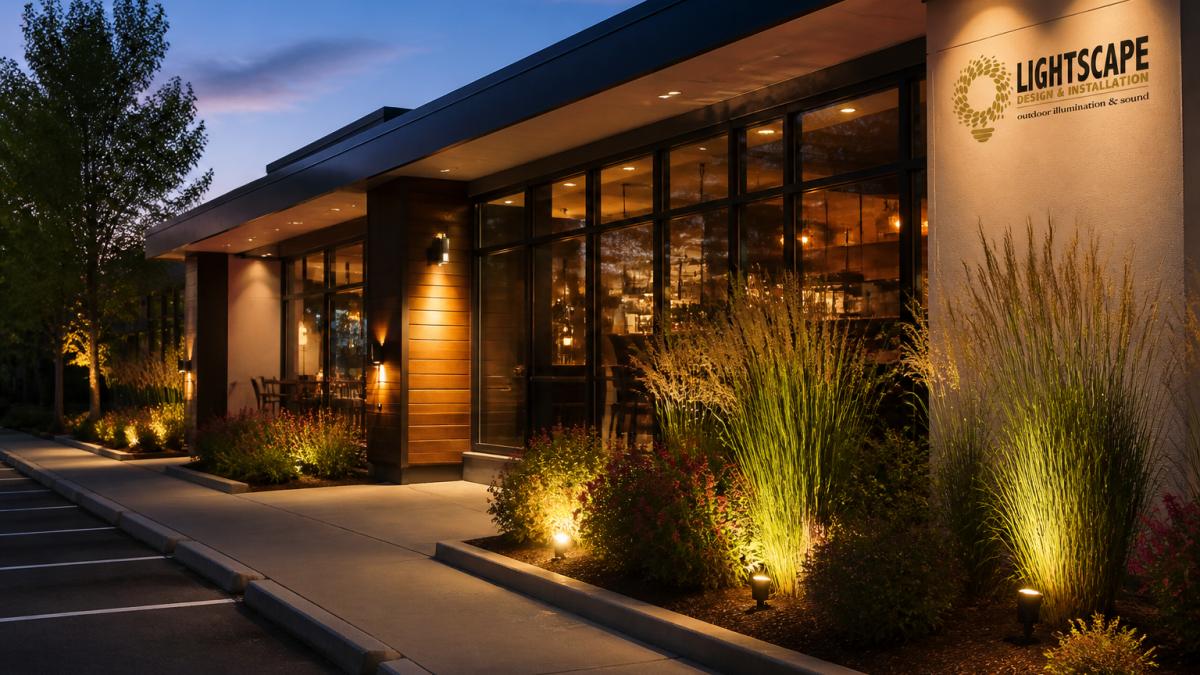
Outdoor lighting for small businesses uses exterior fixtures to extend operating hours, protect people and property, and shape how customers perceive a storefront after dark. At Lightscape Design & Installation, we treat it as infrastructure, not decoration: a well-designed system deters crime, draws people in, and makes a property look cared for.
Security and Safety After Dark
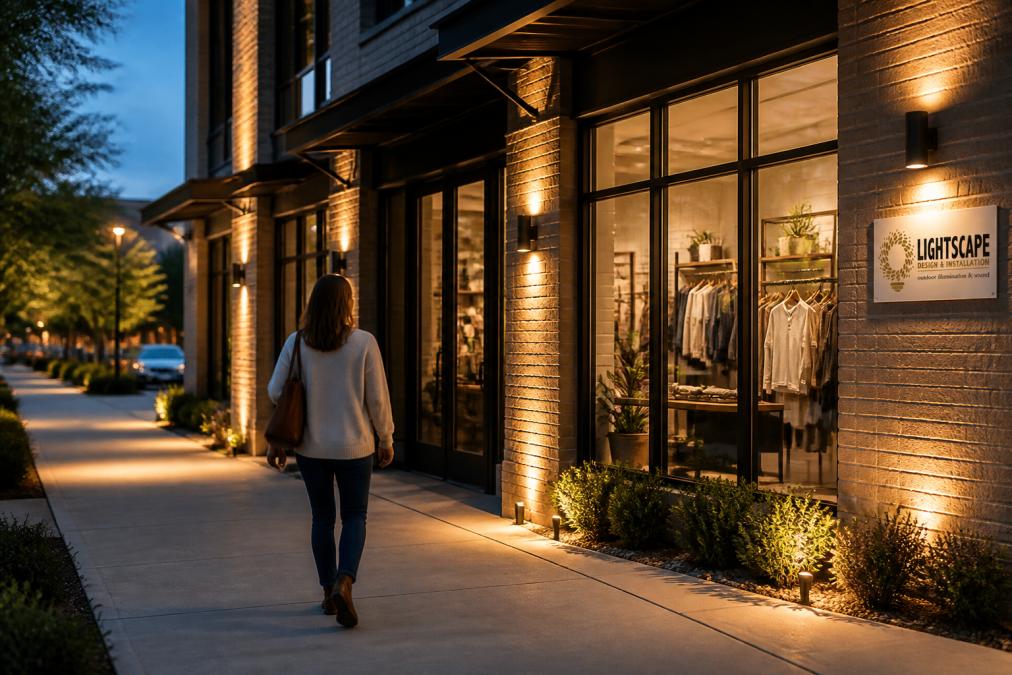
Darkness is where liability lives. A customer tripping on an unlit curb, or an employee walking to a car in a blacked-out lot, is a real risk. Security lighting removes hiding spots and makes the path from door to vehicle legible.
Curb Appeal and Customer Draw
A storefront that reads clearly from the street at night gets more walk-ins. The eye is drawn to contrast, warmth, and definition, so lighting the right architectural features beats lighting everything evenly.
LED Landscape Lighting for Businesses: Efficiency That Pays Back
LED landscape lighting for businesses dominates in 2026 because it combines low energy draw with long service life. Integrated LED fixtures, where the diode is built into the housing rather than socketed as a bulb, outlast halogen and eliminate recurring bulb swaps.
Commercial Outdoor Security Lighting Requirements You Need to Know
Commercial outdoor security lighting requirements vary by property type and jurisdiction, but most businesses answer to overlapping rules: building and electrical code, life-safety code governing egress and parking, local zoning and lighting ordinances, and lease terms from your insurer or landlord. There is no single federal mandate for exterior lighting on private commercial property, the rules come from your municipality, your insurance carrier, and industry standards, and they don't always agree.
The Codes and Standards That Actually Apply
Four documents show up again and again in commercial exterior lighting specs:
- NFPA 70 (National Electrical Code), governs the wiring, grounding, GFCI protection, and wet-location ratings for anything you install outdoors. Your electrical inspector enforces this.
- NFPA 101 (Life Safety Code), sets minimum illumination for means of egress, including exterior exit paths and parking areas serving assembly and business occupancies.
- IES recommended practices, the Illuminating Engineering Society publishes illuminance targets for parking facilities, walkways, and building exteriors. These are recommendations, not law, until a jurisdiction adopts them by reference.
- Local zoning and lighting ordinances, the layer most small business owners get surprised by, and the one most likely to trigger a fine.
Lumens, Coverage, and Parking Lot Standards
Lumens measure light output; wattage measures power draw. Confusing them is a common spec error. A parking lot needs enough lumens to make faces and license plates identifiable from a reasonable distance, distributed evenly to avoid dark gaps between poles.
Two metrics matter more than raw output:
- Uniformity ratio, the ratio of the brightest point to the darkest point across the lit area. A lot with a very bright pole and deep shadows between poles fails the intent of the standard even if the average illuminance looks fine on paper.
- Vertical illuminance, light hitting a vertical surface, like a face or a license plate. This is what makes a person identifiable to a camera or a witness, and it is separate from the horizontal light hitting the pavement.
Zoning, Dark-Sky Rules, and Local Lighting Ordinances
Many cities and counties enforce lighting ordinances that cap light trespass, glare, and upward light. These rules protect neighbors and reduce light pollution, and can dictate fixture shielding, mounting height, color temperature, and curfew hours after which non-security lighting must dim or shut off.
The compliance vocabulary you will encounter:
- Full cutoff, a fixture that emits no light above the horizontal plane. Many ordinances require this for parking and area lighting.
- Light trespass limits, a cap on how much light crosses the property line, often expressed in footcandles measured at the neighbor's boundary.
- BUG rating, a backlight/uplight/glare classification used to specify compliant fixtures. If your ordinance cites a BUG rating, the fixture spec sheet will list it.
- Correlated color temperature caps, some jurisdictions restrict outdoor lighting to warmer color temperatures (often 3000K or below) to reduce sky glow and ecological impact.
Positioning Lights for Security Cameras
This is where a small business owner can lose the value of a camera system they already paid for. Lighting and cameras must be designed together, because the wrong light makes footage worse, not better.
Three rules of thumb:
- Never point a fixture at the camera lens. Direct light into a camera creates lens flare and washes out the entire frame. Aim fixtures so the light falls on the subject, not into the lens.
- Light the approach, not just the door. A camera sees what the light reveals. If the sidewalk, alley, or parking approach is dark, the camera records a silhouette. Illuminate the path a person walks before they reach the entrance.
- Match color temperature to the camera. Mixing a warm 2700K fixture with a cool 5000K fixture in the same camera frame produces color casts that make identification harder. Keep the fixtures visible in a single camera's field of view in the same color temperature family.
What to Verify Before You Buy
A short pre-purchase checklist that prevents most compliance problems:
- Call the zoning office and ask whether your property is in a lighting overlay district or subject to a dark-sky ordinance.
- Ask whether the project requires an electrical permit, a zoning review, or both.
- Request the fixture spec sheets and confirm cutoff classification, BUG rating, and color temperature against the ordinance.
- Confirm with your insurer whether they have their own minimum illuminance requirement for the parking area, it is often stricter than the code.
- Document the pre-installation light levels if a neighbor has complained in the past, so you have a baseline.
The Real Cost of Commercial Outdoor Lighting Installation
The cost of commercial outdoor lighting installation depends on fixture count, voltage requirements, trenching distance, and whether the property needs new circuits or transformer capacity. There is no honest flat number, and any contractor quoting one before walking the site is guessing.
What drives the total:
- Fixture quantity and quality - premium sealed fixtures cost more upfront and less over time
- Wiring and trenching - longer runs and hardscape crossings add labor
- Transformer and voltage planning - low-voltage systems need correctly sized transformers
- Controls - photocells, timers, and smart controllers add capability and cost
- Permits and inspection - required in many jurisdictions
Solar-Powered and Smart Lighting Options for Small Business
Solar-powered and smart lighting options let a small business cut wiring costs and control output from a phone. Solar fixtures suit locations where trenching is impractical or expensive, such as remote signage or detached structures.
Call to schedule a consultation →
| Option | Best For | Trade-Off |
|---|---|---|
| Solar-powered | Remote or trench-limited spots | Output depends on sun exposure |
| Smart controls | Scheduling and dimming needs | Requires reliable network |
| Motion sensors | Low-traffic security zones | Can feel reactive, not welcoming |
| Photocell + timer | Simple dusk-to-dawn operation | Less granular control |
Installation Logistics: Voltage, Weatherproofing, and Safety Tips
Installation logistics decide whether a good design survives its first winter, and its inspection. The two decisions that drive everything else are voltage class and who is legally allowed to do the work.
Low Voltage vs. Line Voltage: What Changes
Low-voltage systems (typically 12V or 24V) are common for landscape lighting because they are safer to route, easier to extend, and use smaller conductors. Line-voltage (120V) is used for higher-output applications like parking lot poles and wall packs.
The practical differences:
- Low voltage runs through a transformer that steps 120V down to 12V or 24V. Because the voltage is low, the shock hazard is reduced and many jurisdictions allow a homeowner or business owner to install it without a licensed electrician, but the transformer itself still plugs into or is wired to a 120V circuit, and that connection is where code applies.
- Line voltage is the same 120V wiring found inside your building. In most jurisdictions, new 120V circuits, panel work, and anything requiring a permit must be performed by a licensed electrician.
DIY vs. Licensed Electrician: Where the Line Sits
Getting this wrong is expensive. The line is not about difficulty, it is about permit and licensing law, which varies by state and municipality.
A reasonable rule of thumb:
- Often DIY-eligible: swapping an existing fixture on an existing circuit, replacing a bulb or integrated LED module, adding a plug-in low-voltage landscape transformer to an existing exterior GFCI outlet, repositioning low-voltage fixtures on existing cable.
- Usually requires a licensed electrician and a permit: running any new 120V circuit, adding a subpanel or breaker, installing parking lot poles, trenching and running line-voltage cable to a new structure, and any work on a commercial property where the local code requires a licensed contractor regardless of voltage.
Trenching and Burial Depth
Trenching is the labor line item that most often blows a budget, and depth requirements vary.
- Low-voltage cable is often permitted at a shallower depth than line voltage, but the exact minimum depends on whether the cable is direct-burial rated, whether it is in conduit, and what your local code adopts. Do not guess, the inspector will measure.
- Line-voltage feeders to parking or landscape structures typically require deeper burial, conduit protection, or both, and may require a call to the 811 "Call Before You Dig" service before any excavation.
- Hardscape crossings, sidewalks, driveways, patios, usually require boring or cutting and patching, which is a significant cost driver. Route around hardscape when the design allows.
Weatherproofing and Safety
Weatherproofing is where bargain installations fail: a fixture rated for damp locations will corrode in a wet one. Sealed, gasketed housings and corrosion-resistant finishes keep a system looking new through rain, snow, and freeze-thaw cycles.
Safety and durability checklist:
- De-energize circuits before any wiring work and confirm with a tester, not just the breaker label.
- Use fixtures, boxes, and connectors rated for wet locations, not damp locations.
- Seal every connection against moisture to prevent corrosion; use gel-filled or heat-shrink connectors on low-voltage splices.
- Verify grounding and GFCI protection where required by code, exterior receptacles almost always require GFCI.
- Bury cable at the depth your local code requires and protect it from lawn equipment and future digging.
- Leave a service loop at each fixture so future repositioning does not require re-trenching.
The two specs that predict long-term satisfaction are fixture sealing and transformer sizing. Get those right and the system runs quietly for years. Get them wrong and you will be replacing components every season, and if you skipped the permit, you may be rebuilding the whole system to pass inspection.
Seasonal and Holiday Lighting That Works Year-Round
Seasonal and holiday lighting doesn't have to be a disposable expense. Design a permanent infrastructure of mounting points, power outlets, and controllers, then swap only the decorative elements each season, so holiday displays plug into a system you already own.
Conclusion
Getting outdoor lighting right means balancing security, aesthetics, compliance, and long-term cost, and that's hard to do alone. Lightscape Design & Installation handles every step, from a complimentary on-site consultation to final aiming, using USA-made premium fixtures with integrated LED technology and a 20-year warranty. Our locally owned team designs glare-conscious, purposeful illumination that elevates beauty, safety, and property value.
Frequently Asked Questions
How many lumens do I need for commercial outdoor security lighting?
Most parking lots and walkways need 10 to 30 lumens per square foot for safe visibility, which typically means 3,000 to 9,000 lumens per fixture depending on pole height and spacing. Entrances and loading zones usually need brighter, more focused light. Your local lighting ordinances and the Illuminating Engineering Society (IES) guidelines set the baseline. A professional site assessment measures ambient light conditions and confirms the right wattage and lumens for your property.
What is the cost of commercial outdoor lighting installation for a small business?
The cost of commercial outdoor lighting installation depends on fixture count, property layout, voltage runs, and whether trenching is needed. A single-storefront accent package costs far less than a full parking lot with pole-mounted fixtures. Solar-powered and low-voltage LED options can reduce wiring expenses. Because pricing varies by scope, request a complimentary on-site consultation for an accurate quote based on your specific property and goals.
Can outdoor lighting improve security without looking like harsh floodlights?
Yes. Layered, glare-conscious designs use warm color temperatures around 2700K to 3000K, shielded fixtures, and motion sensors to illuminate entries, walkways, and parking areas without the harsh look of gas-station floodlights. Pairing photocell and dusk-to-dawn controls with directional landscape lighting keeps light where you need it, reduces light pollution, and maintains curb appeal while still meeting commercial outdoor security lighting requirements.
How do I calculate the ROI of LED landscape lighting for businesses?
Start by comparing your current energy use to an LED system: LEDs use 50 to 75 percent less wattage for the same lumens, and integrated fixtures eliminate bulb replacement costs. Add maintenance savings (no relamping, fewer service calls), potential security-related insurance discounts, and extended evening hours for customers. Most small businesses see operating expenses drop within the first few years, with property value and curb appeal gains continuing long after.