 ultimate-guide
Why Choose LED Landscape Lighting: A 2026 Guide
Table of Contents
- Why Choose LED Landscape Lighting? The Short Answer
- LED vs. Halogen Landscape Lighting: The Real Differences
- How Low-Voltage LED Landscape Lighting Works
- LED Landscape Lighting Cost: A Transparent Lifetime Breakdown
- Best Landscape Lighting Fixtures for Homes and Businesses
- Designing With Light: Layering, Placement, and Glare Control
- What Most LED Lighting Advice Gets Wrong
- Conclusion: Making the Call on LED Landscape Lighting
- Frequently Asked Questions
Last Updated: October 12, 2026
Why Choose LED Landscape Lighting? The Short Answer
LED landscape lighting has become the standard for outdoor illumination because it uses a fraction of the electricity of older bulbs, lasts for years without replacement, and produces warmer, more controllable light.
At Lightscape Design & Installation, we design and install low-voltage LED systems across the St. Louis area, and the shift away from halogen and incandescent bulbs is now close to total.
Below: the real differences between LED and halogen, how low-voltage systems work, what drives lifetime cost, and how to choose fixtures that last.
LED vs. Halogen Landscape Lighting: The Real Differences
The core difference is how each technology makes light. Halogen and incandescent bulbs pass current through a filament, wasting most of that energy as heat. LEDs convert electricity to light directly, so far less is lost.
Wattage, Heat, and Rated Life
A halogen lamp in a typical landscape fixture often runs 20 to 50 watts, while a comparable LED fixture does the same job at a small fraction of that draw.
Heat is the other quiet advantage. Halogen fixtures get hot enough to scorch nearby foliage and degrade their own sockets. LEDs run cool, protecting plants and extending fixture life.
Rated life tells the same story. Halogen bulbs are commonly rated in the low thousands of hours, so a nightly system may need replacement bulbs within a year or two.
Light Quality and Color Temperature
Color temperature matters more than most buyers expect. Halogen produces a warm, slightly amber light that flatters stone, brick, and wood, while early LEDs had a reputation for harsh blue-white output that still scares people off.
Modern LEDs span the full range, from warm tones that mimic halogen to cooler whites for security and commercial use. A well-designed system matches color temperature across every fixture so the property reads as one coherent scene rather than a patchwork, while beam angle and light distribution control whether light lands as a tight spotlight on a tree trunk or a wide wash across a walkway.
U.S. Department of Energy guidance on LED lighting
How Low-Voltage LED Landscape Lighting Works
Low-voltage LED landscape lighting steps standard household current down to a safer, lower voltage through a transformer, then distributes it to fixtures through buried cable. That lower voltage is why these systems are considered safer around soil, water features, and walkways.
Transformers, Voltage Drop, and Safe Installation
The transformer is the heart of the system: it converts line voltage to low voltage and determines how many fixtures the system can support.
Voltage drop is the detail most DIY guides gloss over.
Electrical safety is not just about the low voltage itself. Connections must be sealed against moisture and the transformer properly sourced, so a licensed, insured installer handles the line-voltage side and weatherproofs every connection to survive freeze-thaw cycles and heavy rain.
LED Landscape Lighting Cost: A Transparent Lifetime Breakdown
LED landscape lighting cost is best understood as a lifetime figure, not a sticker price. The upfront expense is real, but it is offset by lower electricity consumption and near-zero bulb replacement over the life of the system.
A Worked Example: Ten Fixtures Over Ten Years
Assume a modest residential system: ten fixtures running an average of six hours per night, 365 nights per year, roughly 2,190 operating hours per fixture annually.
A halogen landscape lamp in the 20 to 35 watt range is a fair stand-in for the older technology.
The difference is about 460 kilowatt-hours per year. At a typical residential rate of 15 to 17 cents per kilowatt-hour, that is roughly $70 to $78 saved annually on electricity alone, before any bulb is replaced.
The Costs the Sticker Price Hides
Electricity is only the visible line item. The larger hidden cost in a halogen system is replacement labor and bulbs: a lamp rated in the low thousands of hours typically needs replacing within a year or two of nightly use.
| Cost Factor | Halogen System (10 fixtures, 10 years) | Integrated LED System (10 fixtures, 10 years) |
|---|---|---|
| Electricity consumption | Roughly 5,900 kWh | Roughly 1,300 kWh |
| Electricity cost at ~$0.16/kWh | Roughly $940 | Roughly $210 |
| Replacement bulbs | Frequent, recurring | None (integrated) |
| Maintenance visits | Regular | Minimal |
| Fixture lifespan | Shorter | Much longer |
| Light quality over time | Degrades with bulb age | Consistent |
These are illustrative figures, not a quote. Actual consumption depends on fixture count, wattage, run time, and local rates, and installation cost depends on cable runs, transformer capacity, and design complexity.
We do not publish fixed pricing because every property is different, fixture count, cable run length, transformer capacity, and design complexity all move the total. The best way to get a real figure is a complimentary on-site consultation where we walk the property and map the layout.
Best Landscape Lighting Fixtures for Homes and Businesses
The best landscape lighting fixtures are built to survive their environment and designed so their light can be aimed precisely. Fixture quality separates a system that looks intentional for a decade from one that looks tired in two years.
Call to schedule a consultation →
What Separates Premium Fixtures From Cheap Ones
Cheap fixtures cut corners you cannot see at purchase. Thin metal, unsealed connections, and non-replaceable modules make the whole fixture disposable, so the fixture is the wrong place to economize.
Lightscape uses premium, USA-made fixtures with integrated LED technology and backs them with a 20-year warranty.
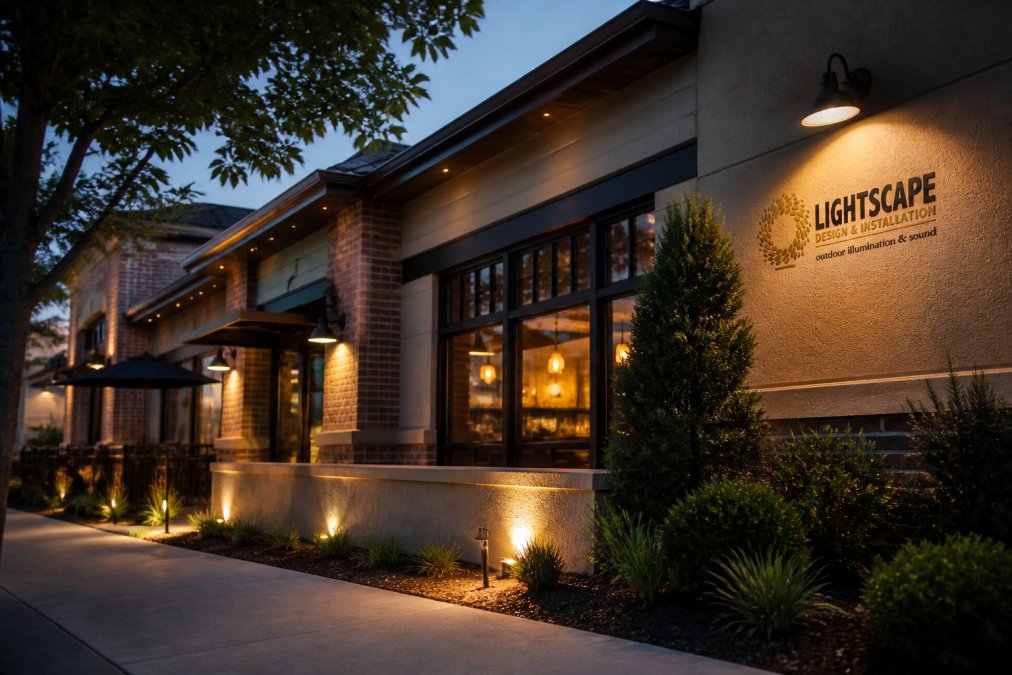
For businesses, the same logic applies to parking lots, entrances, and building facades. Good fixtures light the area without turning it into a floodlit lot, protecting both visibility and the property's appearance.
Designing With Light: Layering, Placement, and Glare Control
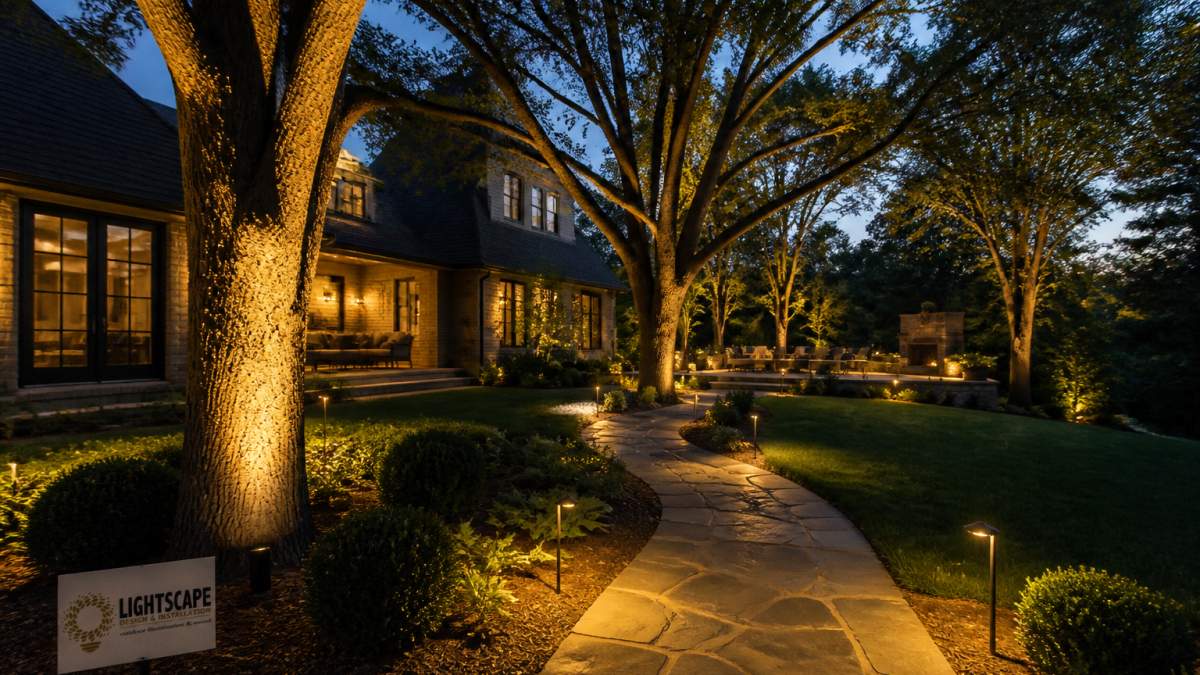
Good landscape lighting is a design problem, not a hardware problem. The goal is layered light that reveals architecture, guides movement, and stays out of the viewer's eyes.
Start With the Layers, Then the Fixtures
Layering means using different fixture types for different jobs, and the order you plan them matters:
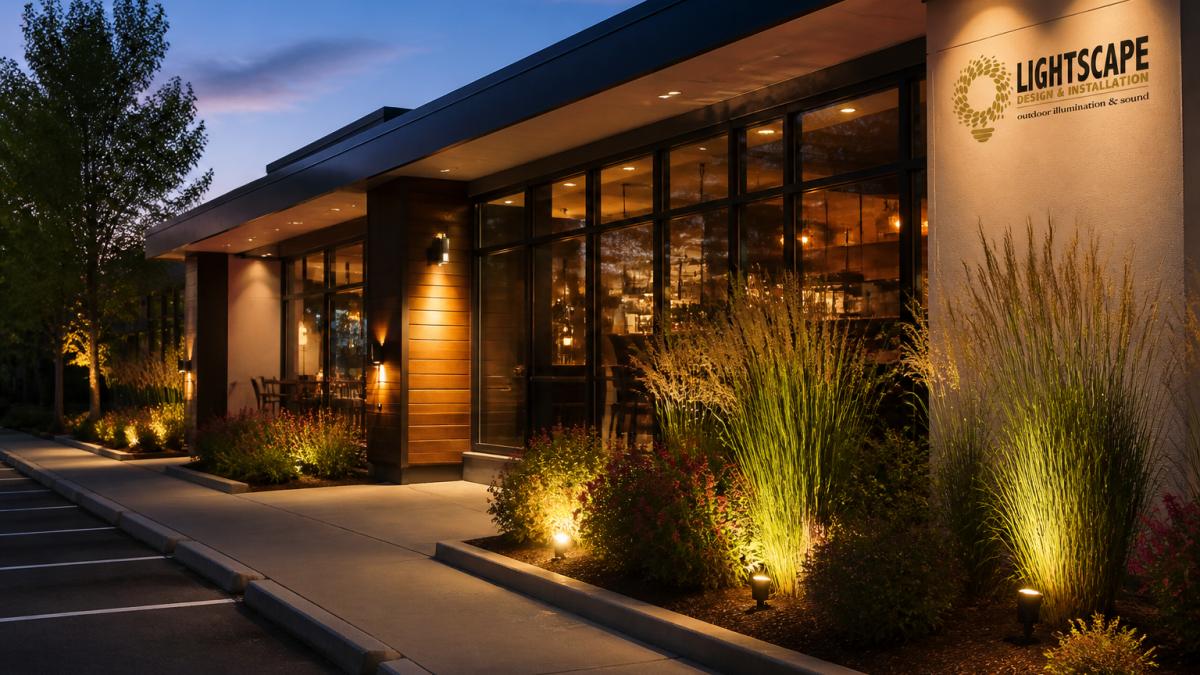
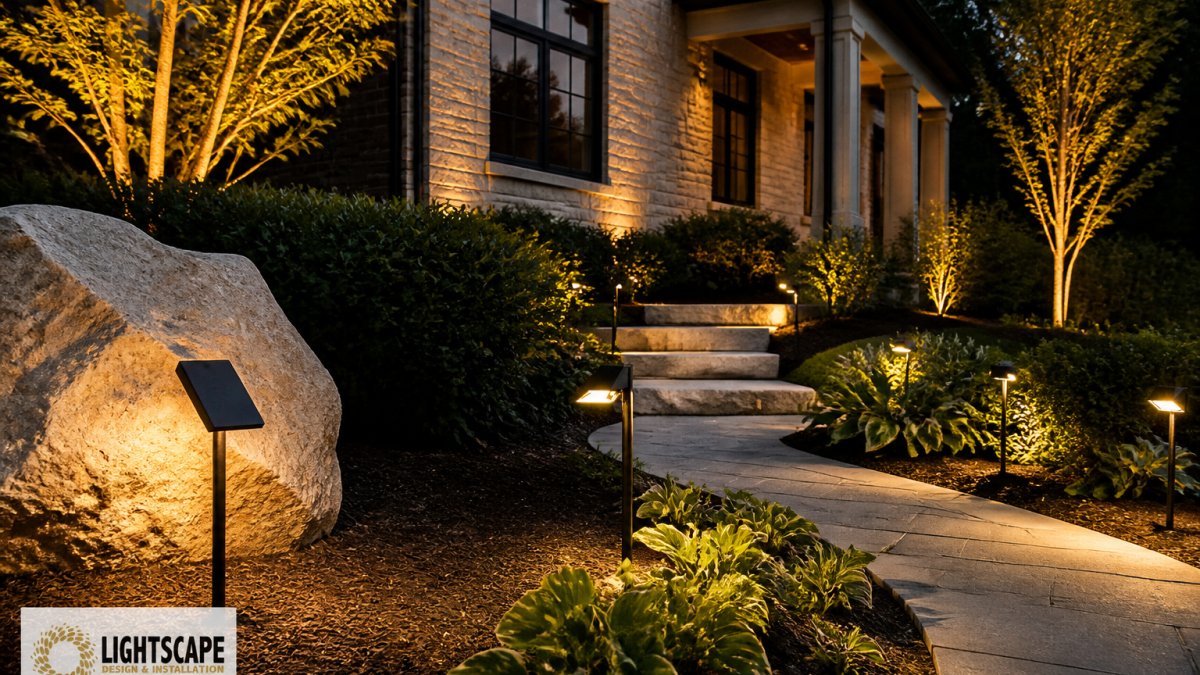
- Path and walkway lighting handles safe movement at ground level. Space fixtures roughly 6 to 10 feet apart, closer on curves and steps, and aim them straight down or slightly outward to pool light on the surface rather than into the eyes of someone approaching.
- Uplighting and spotlights graze tree trunks and architectural features to add depth. A narrow beam (10 to 25 degrees) suits a tall trunk or column; a wider beam (30 to 60 degrees) washes a wall or low hedge.
- Downlighting from trees or structures washes soft light onto patios and garden beds. Mount fixtures high enough to spread light evenly and low enough to avoid glaring into windows.
- Accent and moonlighting fills the gaps, one well-aimed fixture on a specimen plant or water feature often does more than several poorly aimed ones.
When these layers work together, the eye reads the whole scene instead of individual fixtures.
Beam Angle, Spacing, and Brightness by Feature
The single most useful rule is to match the beam to the object, not the other way around:
- Tree trunks and columns: narrow beam, 10 to 25 degrees, aimed up the trunk from a few feet away.
- Tree canopies: wider beam, 30 to 45 degrees, positioned so the light reaches the lower branches without blasting past them.
- Walls and facades: wide wash, 45 to 60 degrees, spaced so overlapping cones eliminate dark gaps.
Brightness should be the last decision, not the first. More light is almost never the answer; the goal is enough contrast to create depth without flattening the scene. Keep accent fixtures dimmer than path fixtures so the eye is drawn along the walk rather than to a single bright object.
Color Temperature: Match the Scene, Not the Trend
For most residential landscapes, warm white in the 2700K to 3000K range reads as natural and flattering on masonry and foliage, while cooler 4000K suits security and commercial applications where visibility matters more than warmth. The key is consistency: match color temperature across every fixture so the property reads as one coherent scene rather than a patchwork.
Aim, Shield, and Control Glare
Placement and glare control are where experience shows: a fixture aimed slightly wrong throws light into a window or a guest's eyes, while shielded, well-aimed fixtures keep light on the subject. Practical rules:
- Aim uplights so the beam hits the trunk or wall, not the sky above it.
- Keep path light heads low and shielded so the source is not visible from the walk.
- Position fixtures so they are not in the direct line of sight from a window, patio, or driveway.
This is also where responsible outdoor lighting comes in: light should fall where it is useful, not spill into the night sky or a neighbor's property. Dark-sky-friendly choices, full cut-off fixtures, lower output, careful aim, reduce light pollution while often improving how the landscape looks.
For the customer worried about big oak trees casting shadows, the answer is deliberate placement and the right beam angle. A well-aimed uplight uses the trunk and canopy to create drama rather than fighting the shade.
What Most LED Lighting Advice Gets Wrong
Most LED lighting advice treats the technology as the whole story. It is not. The technology is settled; the execution is where systems succeed or fail.
The first thing most guides miss is that not all LEDs are equal: fixture quality, optics, and sealing vary enormously, and a cheap LED can underperform a well-built halogen fixture. The second is compatibility, integrated LED fixtures are not designed around replaceable bulbs, so repairability and warranty coverage become the real long-term question.
The throughline: LED landscape lighting is a design and installation discipline, not a product you drop in. The light you see at night is the result of planning, aiming, and hardware that holds up.
Conclusion: Making the Call on LED Landscape Lighting
Deciding on LED landscape lighting comes down to whether you want a system that looks right and stays right. The upfront cost is higher than a halogen setup or a box of fixtures shipped to your door, and that gap is real. What closes it is years of lower electricity use, no bulb runs, and hardware designed to last.
Frequently Asked Questions
Do LED landscape lights really use less electricity than halogen?
Yes. A typical halogen landscape bulb draws 20 to 50 watts, while an LED fixture producing comparable light output uses roughly 4 to 12 watts. That difference compounds across a system with 15 or more fixtures running several hours each night. Lower wattage also means a smaller transformer can carry more fixtures, which reduces equipment needs and keeps electricity consumption down over the entire season.
How long do LED landscape lights last compared with halogen bulbs?
Quality integrated LED fixtures are rated for roughly 50,000 hours of operation, compared with about 2,000 to 4,000 hours for halogen bulbs. At four hours of nightly use, that is more than 30 years of rated life for LED versus roughly two to three years for halogen. Integrated LED fixtures also have no replaceable bulb, so there is nothing to swap out or reseat each season.
Is there a real difference between cheap and premium LED landscape fixtures?
The difference shows up in the housing material, the driver electronics, the lens, and the warranty. Inexpensive fixtures often use plastic housings, unsealed drivers, and lenses that yellow within a few seasons, which shifts color and reduces output. Premium USA-made fixtures use machined metal bodies, potted drivers, and glass lenses, and they typically carry warranties measured in decades rather than months.
Can LED landscape lights run on a low-voltage system?
Yes, and low-voltage LED landscape lighting is the standard approach for residential and commercial properties. Most systems run on 12 or 24 volts through a transformer that steps down household current. Because the voltage is low, the wiring does not need to be buried as deeply as line-voltage cable, and the risk of serious shock is greatly reduced. The main design consideration is voltage drop over long wire runs, which is why fixture count and wire gauge matter.
If you are weighing that investment, the challenge is getting a design that flatters your property without glare or over-lighting, and hardware that will still be under warranty years from now. Lightscape Design & Installation handles the full process, from a complimentary on-site consultation to final aiming, using premium USA-made fixtures, integrated LED technology with no bulbs to replace, and a 20-year warranty. Call to schedule a consultation and see how your property looks after dark.