 how-to
Landscape Lighting Clarkson Valley MO: 2026 Design Guide
Table of Contents
- Landscape Lighting Clarkson Valley MO: Why Design Comes First
- Landscape Lighting Design That Fits Clarkson Valley Properties
- Pathway and Step Lighting for Safety and Evening Flow
- Integrated LED Landscape Lighting: What It Means for Longevity
- Tree Uplighting and Architectural Accents: Placement, Beam Angles, and Glare Control
- Low-Voltage Systems: Transformers, Wiring, and Energy Use
- Landscape Lighting Maintenance and Seasonal Care
- Professional Installation vs. DIY and Solar: What Clarkson Valley Homeowners Should Know
- Frequently Asked Questions
Last Updated: October 17, 2026
Landscape Lighting Clarkson Valley MO: Why Design Comes First
Most outdoor lighting fails not because the fixtures are cheap, but because nobody planned the layers. That is the core of professional landscape lighting Clarkson Valley MO homeowners actually benefit from: a plan drawn for the lot, not a kit pulled off a shelf.
Clarkson Valley properties tend to share a few traits: large lots, established trees, long approaches, and homes with real architectural detail worth showing after dark. Those traits reward restraint. Light three things well and the whole yard reads as intentional.
Below, we break down how design, placement, and system choices work together, and where cheap alternatives fall short.
Landscape Lighting Design That Fits Clarkson Valley Properties
Landscape lighting design is the practice of choosing what to illuminate, what to leave dark, and how much light each feature receives. Good design starts with a nighttime walk of the property, not a catalog.
Reading the Lot: Mature Trees, Slopes, and Setbacks
A common mistake is treating every property the same. A flat half-acre in Kirkwood and a wooded, sloping lot in Clarkson Valley need different fixture counts, different beam spreads, and different transformer loads. Mature trees cast heavy shadow, so we aim light at trunks and lower canopies rather than fighting the shade. Slopes change sightlines from the street, which affects where uplights can sit without being seen.
What most guides miss is that the view from the street matters as much as the view from the patio. We design for both.
Pathway and Step Lighting for Safety and Evening Flow
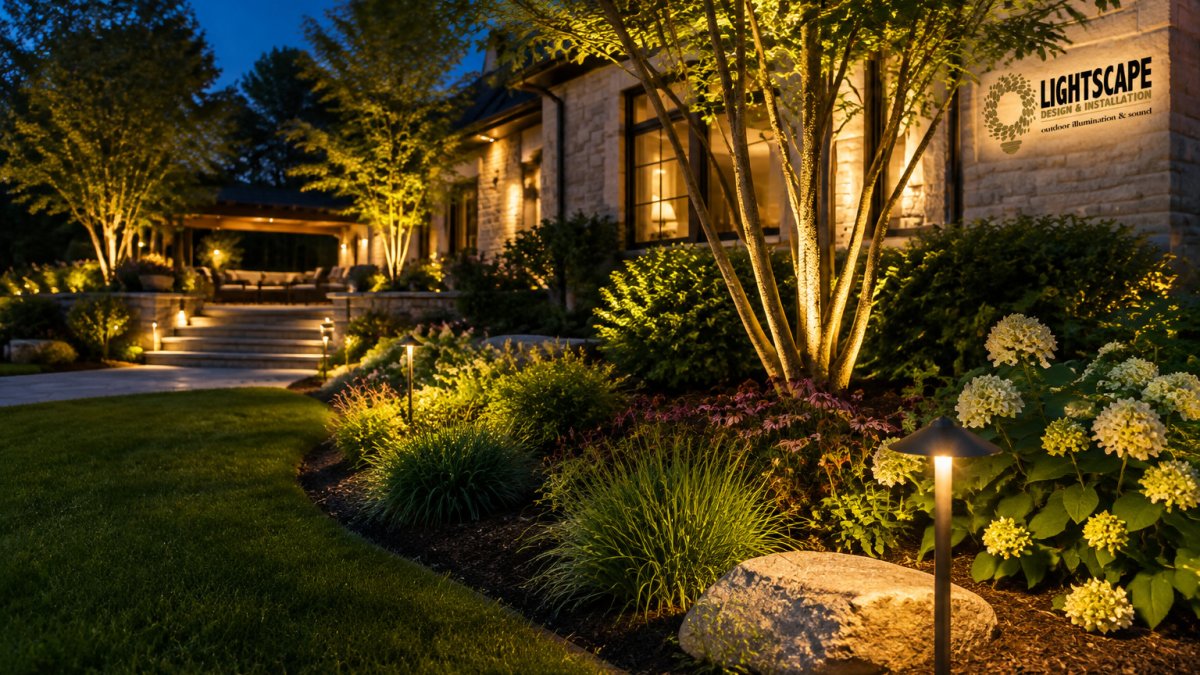
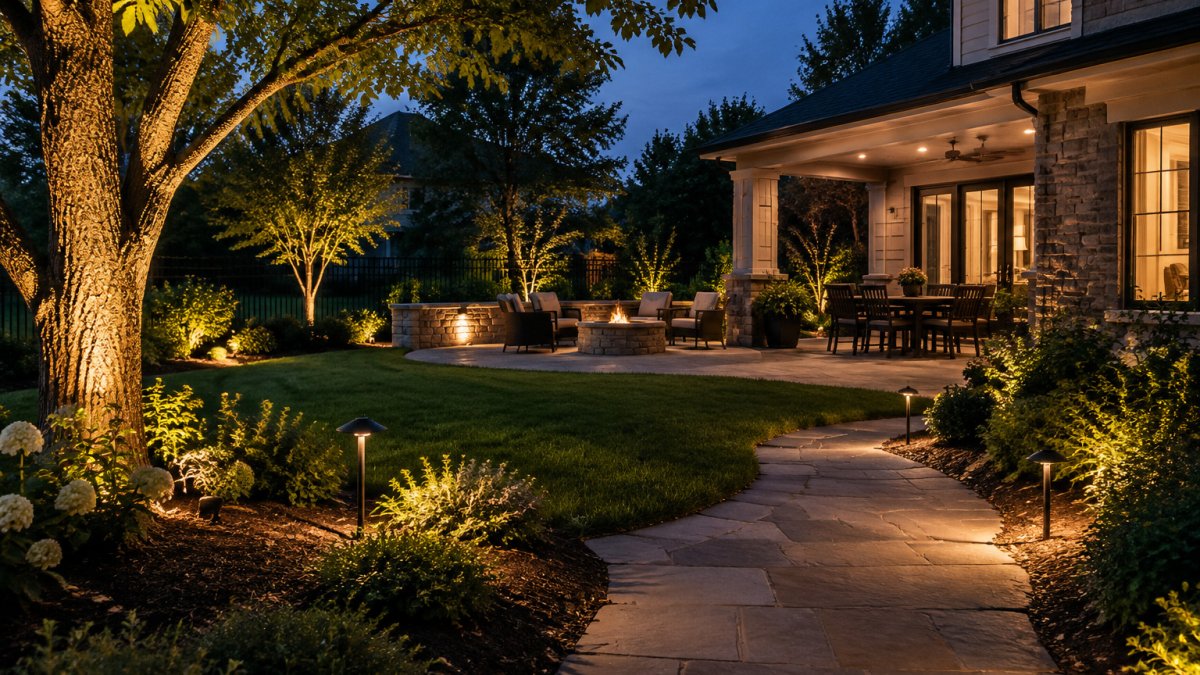
Pathway and step lighting does two jobs at once: it keeps guests safe and it guides the eye through the yard. The best path lighting is felt more than seen. Fixtures should throw a soft pool of light across the walk, not a bright cone into someone's eyes.
- Space fixtures to create an even rhythm along the walk, adjusting for curves and grade changes
- Use shielded fixtures so the source stays hidden from normal viewing angles
- Light steps at the tread and riser so edges read clearly without glare
- Keep path light levels lower than feature lighting so the landscape stays the star
Glare control is where cheap installations show their seams. A bright, unshielded path light at eye level ruins the mood of an otherwise beautiful yard. Our fixtures are specified with beam spreads and shields chosen for each location, so the light lands where it should.
Integrated LED Landscape Lighting: What It Means for Longevity
Integrated LED landscape lighting means the LED array is built into the fixture rather than plugged in as a replaceable bulb. There is no socket to corrode, no bulb to source years later, and no mismatch when one lamp ages differently from its neighbors.
That matters in a climate with real seasonal swings. Replaceable-bulb systems invite water intrusion at the socket and color drift as bulbs are swapped over time. Integrated fixtures hold their color temperature, so the whole system stays consistent from the first fixture to the last.
Tree Uplighting and Architectural Accents: Placement, Beam Angles, and Glare Control
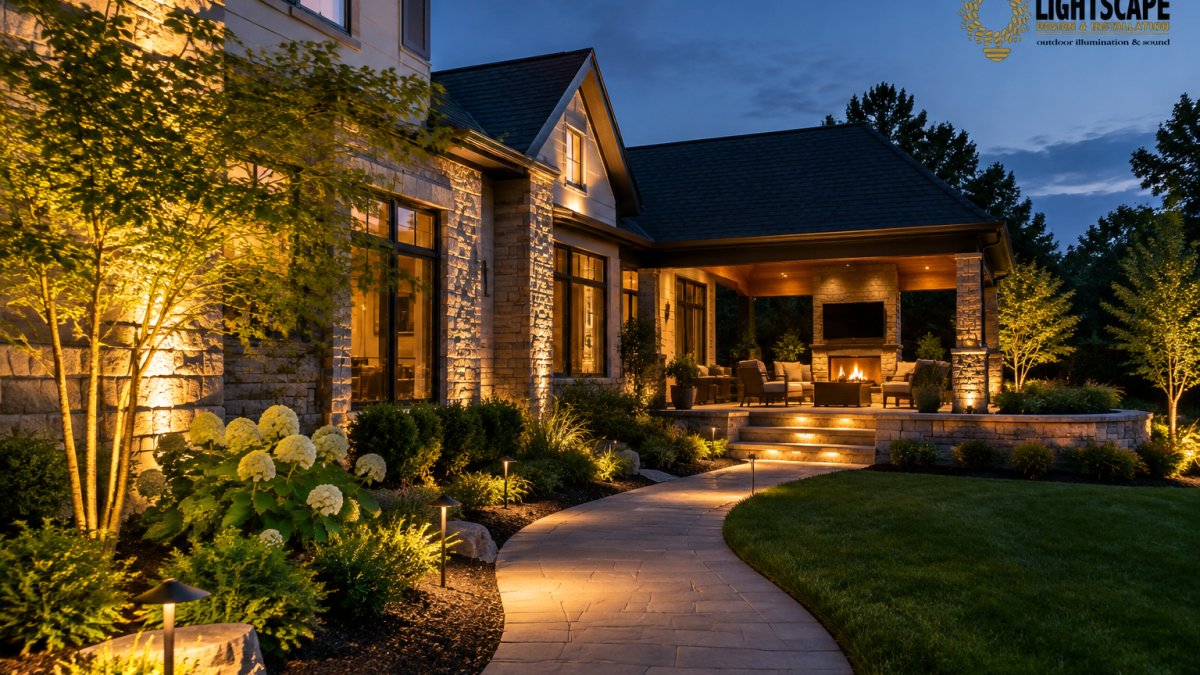
Tree uplighting and architectural lighting succeed or fail on placement and beam angle. A narrow beam on a tall trunk reaches the canopy; a wide beam washes the base and dies out.
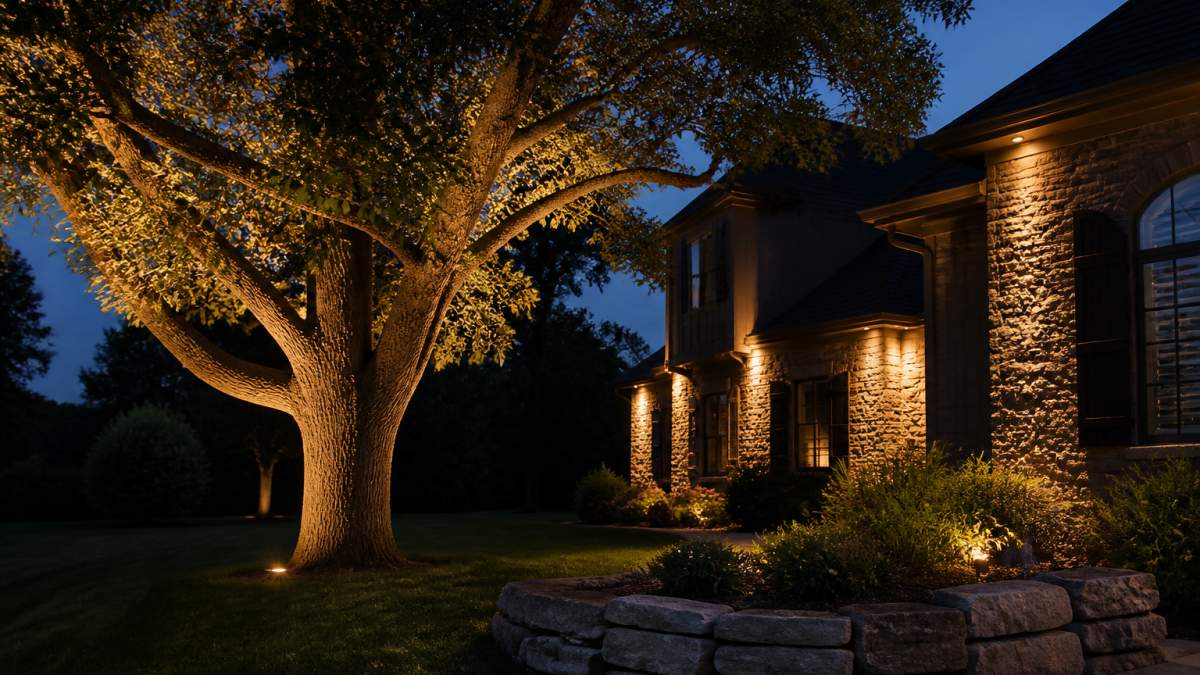
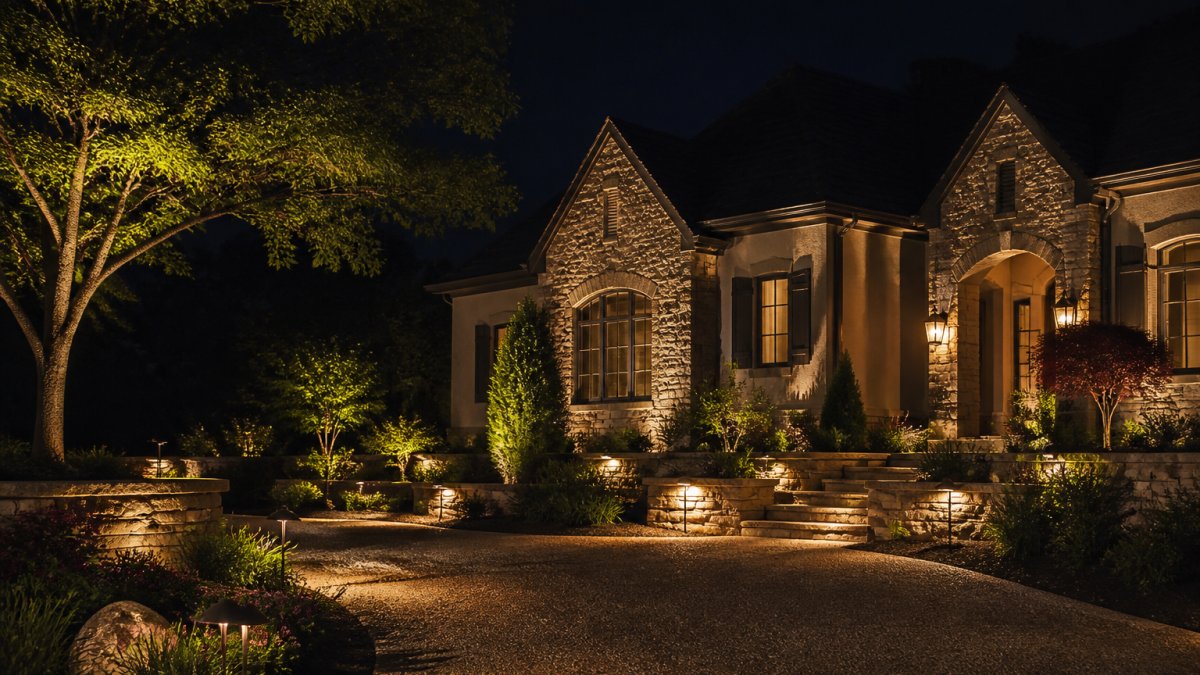
Glare control is the other half. Fixtures sit close to the trunk or wall, angled so the source is hidden from the main viewing areas. For architecture, we use downlighting and moonlighting through the canopy to graze stone and siding rather than blast it.
Low-Voltage Systems: Transformers, Wiring, and Energy Use
Most residential landscape lighting in the U.S. runs on a low-voltage system, typically 12 to 15 volts rather than the 120 volts that feeds your outlets. A transformer plugged into a standard outdoor GFCI receptacle steps household power down to that safer level, and from there a buried cable carries power to each fixture. Understanding those three parts, transformer, cable, fixture, explains why two yards with the same number of lights can perform very differently.
Transformer Sizing
The transformer must be sized to the total load of the fixtures it serves, with headroom for future additions. Load is calculated from each fixture's wattage: add up the schedule, then plan capacity above that total so the system is not running at its ceiling. An undersized transformer shows up as dimming at the far end of the run, flicker, or a unit that runs hot and fails early. An oversized one is not harmful, but it is money spent on capacity the property may never use. We size from the actual fixture schedule, not a rule of thumb.
Voltage Drop and Wiring
Voltage drop is the loss of voltage as power travels down a cable, and it is the single most misunderstood part of low-voltage design. On a large lot with long runs, the fixtures at the end of the cable can receive noticeably less voltage than the ones near the transformer, which is why the far end of a poorly planned system looks dim or warm-shifted. The fix is planning cable gauge and run length together, and in some cases running multiple home runs from the transformer rather than one long daisy chain.
Request a Lighting Consultation Today →
Connections and Longevity
Every connection point is a place water can enter. We use waterproof connectors rated for direct burial and keep connections above grade where practical, because a corroded splice is one of the most common causes of a fixture that mysteriously stops working. Integrated LED fixtures remove the socket, historically the weakest point in an outdoor fixture, from the equation entirely.
Energy Use
Because the system is low-voltage and LED-based, the electricity draw is modest relative to the visual impact. A typical residential system uses a fraction of the power of the same number of incandescent fixtures, and integrated LED arrays are engineered to hold their output and color over years of nightly use rather than dimming noticeably the way older bulbs did.
Landscape Lighting Maintenance and Seasonal Care
Landscape lighting maintenance is mostly about small adjustments and seasonal checks, not repairs. Plants grow, mulch shifts, and fixtures settle. A system that looked perfect in spring can be blocked by a shrub by July.
- Re-aim fixtures after seasonal growth and any landscape changes
- Clear debris and mulch from around fixture heads
- Check connections and transformer settings at the start of each season
- Clean lenses so output and color stay true
We build maintenance into the relationship rather than treating it as an afterthought. A quick seasonal visit protects both the look and the warranty.
Professional Installation vs. DIY and Solar: What Clarkson Valley Homeowners Should Know
Homeowners comparing outdoor lighting options usually land on three paths: a professional design-and-install system, a DIY low-voltage kit, or solar fixtures. Each has a place, and being honest about where each one works, and where it does not, is more useful than a blanket recommendation.
Where Solar Fits, and Where It Doesn't
Solar path lights need no wiring, which makes them genuinely convenient for a rental, a temporary setup, or a spot with full sun. The limitation is physics: output depends on how much sun the panel receives, and a shaded lot under mature trees is exactly where solar struggles. On a wooded Clarkson Valley property, solar fixtures often produce a weak, inconsistent glow that fades by late evening. They also tend to use plastic housings and unshielded output, so glare and short service life are common trade-offs.
Where DIY Kits Fit, and Where They Don't
A DIY low-voltage kit can work on a simple, short walkway where the goal is basic visibility. What kits rarely handle is layered design: voltage drop over long runs, glare control, beam matching to tree height, and the aiming that makes a system look intentional rather than assembled. On a property with real scope, long approaches, mature trees, architectural detail, a kit tends to produce a flat, even wash of light rather than depth. The kit is also sold as a fixed package, so the fixture count and beam spreads are chosen by the manufacturer, not the lot.
What Professional Design Adds
Professional landscape lighting installation differs in design, fixture quality, and what happens after the install. A designer walks the property at night, chooses what to illuminate and what to leave dark, matches wattage and beam spread to each feature, and aims every fixture by hand. The fixtures themselves are built for the outdoors, USA-made housings, integrated LED arrays without replaceable bulbs, and consistent color temperature across the system, and the work is backed by a 20-year limited fixture warranty. When something needs attention, there is a team to call rather than a box to return.
When to Call a Licensed Electrician
Low-voltage landscape lighting is generally within the scope of a lighting installer, but any work that touches household line voltage, adding an outdoor receptacle, running a new circuit from the panel, or troubleshooting a GFCI that keeps tripping, should go to a licensed electrician. A reputable lighting company will tell you when a project crosses that line rather than stretch its scope.
A Simple Decision Framework
- Rental, temporary setup, or a single sunny spot: solar is a reasonable stopgap.
- A short, simple walk with basic visibility as the goal: a DIY kit can work.
- A property with mature trees, architectural detail, long approaches, or a desire for layered nighttime ambiance: professional design pays for itself in how the yard reads after dark.
If you want the yard to look deliberate after dark, start with a conversation. Lightscape Design & Installation offers a complimentary on-site consultation and nighttime lighting demonstration, so you can see the design on your own property before committing. Visit our contact page to schedule yours.
Frequently Asked Questions
What does professional landscape lighting include?
A professional landscape lighting project covers design, fixtures, low-voltage wiring, transformer sizing, installation, and aiming. It typically includes pathway and step lighting, tree uplighting, architectural accents, and hardscape lighting. At Lightscape Design & Installation, we start with a complimentary on-site consultation and nighttime demonstration, then handle fixture placement, beam angles, and glare control. Our USA-made fixtures use integrated LED technology with no bulbs to replace and carry a 20-year limited warranty. We also provide ongoing landscape lighting maintenance to keep the system performing season after season.
How can landscape lighting improve a home's curb appeal?
Landscape lighting extends your home's curb appeal into the evening by highlighting architecture, trees, and walkways that disappear after dark. Thoughtful landscape lighting design creates depth and warmth, guiding guests safely along pathway and step lighting while accenting stone, siding, and mature trees. For luxury homes in Clarkson Valley, this layered approach adds nighttime ambiance for entertaining and improves security without harsh floodlights. A professionally aimed system avoids glare and keeps the look natural, so the property reads as welcoming rather than overly lit.
What is the difference between professional landscape lighting and solar lights?
Professional landscape lighting uses a low-voltage system with a transformer, durable USA-made fixtures, and integrated LED landscape lighting designed for consistent output and color. Solar lights rely on stored daylight and often dim or fade, with limited beam control and shorter lifespan. Professional installation allows customized wattages and beam spreads, precise fixture placement, and glare control that solar fixtures cannot match. The result is even, warm illumination across pathways, trees, and architecture. Lightscape backs its fixtures with a 20-year limited warranty and offers landscape lighting maintenance for long-term performance.
How do I choose a landscape lighting company serving Clarkson Valley?
Look for a local company with design expertise, not just installation. Ask to see a nighttime demonstration so you can judge beam angles, color temperature, and glare control on your own property. Confirm the company is licensed, bonded, and insured, and ask about fixture quality, warranty length, and ongoing landscape lighting maintenance. A provider experienced with Clarkson Valley properties will understand mature trees, slopes, and neighborhood constraints. Lightscape Design & Installation offers a complimentary consultation and nighttime demonstration; schedule one at https://lightscapestl.com/contact-us.