 how-to
Safe Outdoor Lighting for Homes: A How-to Guide
Table of Contents
- Start With a Plan: Mapping Safe Outdoor Lighting for Homes
- Outdoor Pathway Lighting That Prevents Trips After Dark
- Outdoor Step Lighting for Stairs, Decks, and Level Changes
- Motion Sensor Outdoor Lights: Security Without the Blast
- Glare-Free Outdoor Lighting and Light Trespass Control
- Weather Ratings and Electrical Safety: What to Check Before You Buy
- Timers, Controls, and Seasonal Maintenance for Safe Outdoor Lighting
- Conclusion
- Frequently Asked Questions
Last Updated: October 18, 2026
Start With a Plan: Mapping Safe Outdoor Lighting for Homes
Safe outdoor lighting for homes starts with a simple principle: light the ground where people walk, light the edges where they could stumble, and keep bright light out of their eyes.
At Lightscape Design & Installation, we plan every property the same way: walk the paths after dark, mark the trip hazards, then choose fixtures that solve those specific problems. A safe outdoor lighting plan covers four zones before you spend a dollar:
- Travel zones: walkways, driveways, and the route from car to door
- Level changes: steps, stoops, deck edges, and retaining walls
- Open ground: patios, pool decks, and lawn edges where guests wander
Sketch your property from above and mark each zone. The Illuminating Engineering Society publishes recommended practices for residential exterior lighting if you want a technical reference for placement and brightness.
Get this map right and everything that follows gets easier.
Outdoor Pathway Lighting That Prevents Trips After Dark
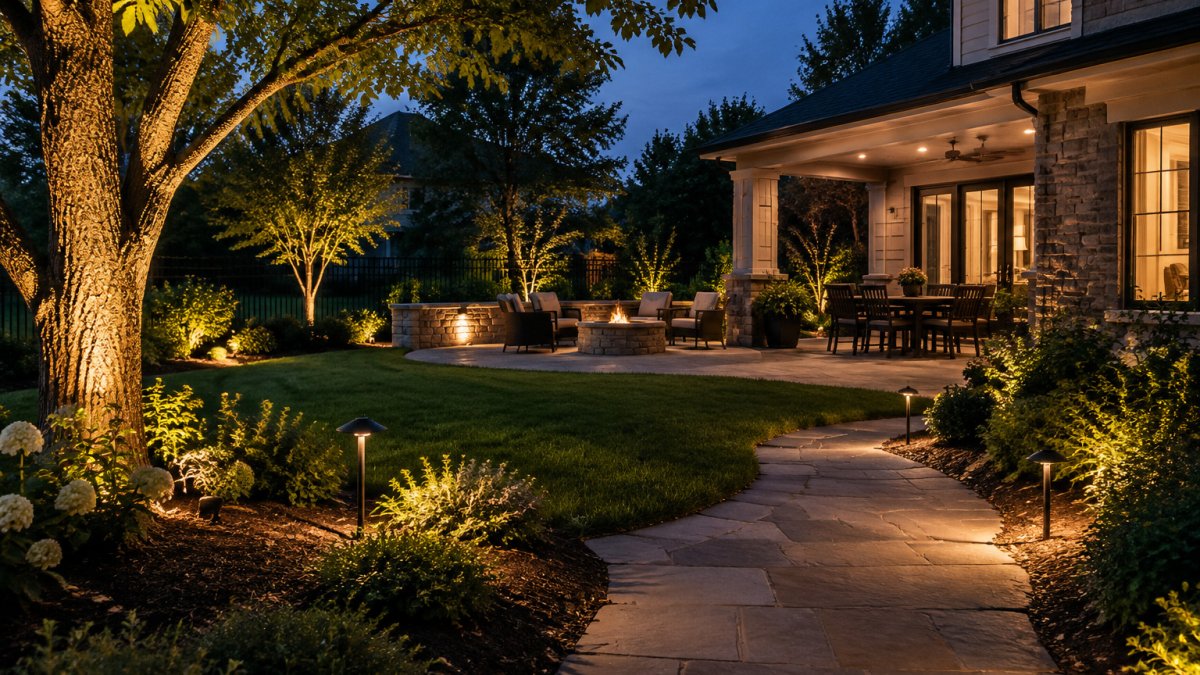
Outdoor pathway lighting exists to do one job: show the walking surface clearly without shining into anyone's eyes.
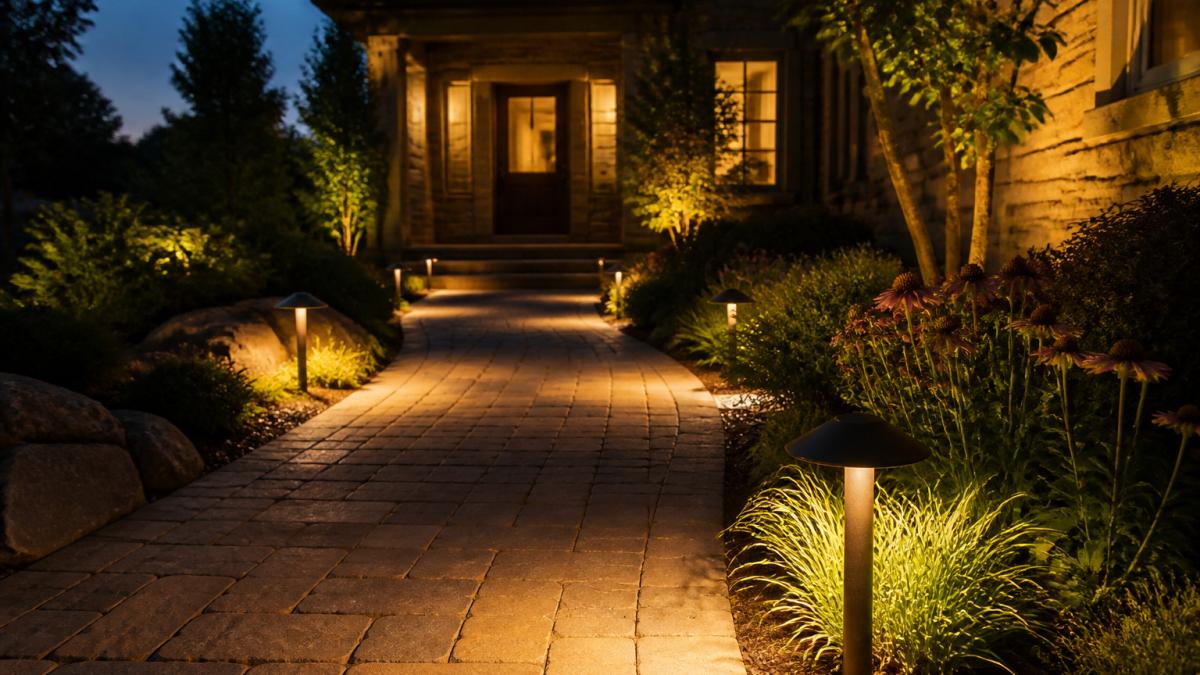
The most common mistake we see is over-lighting a path. A row of bright fixtures creates harsh contrast, and the eye adjusts to the glare, which actually makes the darker areas harder to see.
A few placement rules that hold up in practice:
- Keep fixtures just off the path edge, not in the middle where they become an obstacle
- Aim the beam across the walkway, not down the length of it
- Shield the lamp so the light source is never visible from standing height
Path fixtures also fail quietly. A cracked lens or a fixture knocked slightly off-aim can throw light sideways into a window. Check them after storms and after lawn crews visit.
Outdoor Step Lighting for Stairs, Decks, and Level Changes
Outdoor step lighting is the single highest-value safety upgrade on most properties. Stairs and level changes cause more falls than any other outdoor feature, and a dark step reads as flat ground to the human eye.
Mount step lights low on the riser or recess them into the tread, aimed downward so the light washes the tread surface and nothing else.
For hardscape stairs, integrated fixtures built into the wall or riser look cleanest and survive weather better than surface-mounted units. That is a job worth planning before the masonry goes in, not after, which is why our Hardscape Lighting Design & Installation is coordinated with your mason or paver crew from the start.
Motion Sensor Outdoor Lights: Security Without the Blast
Motion sensor outdoor lights are useful for security, but most homeowners set them up wrong.
Here is the honest trade-off: motion lights deter intruders by surprise and illumination, but they also create dark gaps when nothing is moving.
A better approach:
- Set sensors to trigger at a moderate brightness, not maximum
- Aim the detection zone at approaches (driveway, side gate, back fence line), not at seating areas
- Choose warm color temperatures so the light reads as residential, not institutional
Motion fixtures near bedrooms and patios should be aimed away from windows and seating. The goal is to see who is approaching, not to flood the yard.
Glare-Free Outdoor Lighting and Light Trespass Control
Glare-free outdoor lighting means the light goes where it is needed and the source stays hidden from view.
Both problems have the same fix: shielding, aiming, and restraint. A shielded fixture with a sharp cutoff keeps the beam on your property.
Light trespass matters for wildlife too. The International Dark-Sky Association publishes guidance on fixtures that minimize sky glow while still lighting what matters.
Weather Ratings and Electrical Safety: What to Check Before You Buy
Weather ratings and electrical safety are where cheap fixtures reveal themselves. Outdoor fixtures face rain, snow, freeze-thaw cycles, sprinkler spray, and summer heat, and a fixture that is not sealed properly will corrode, flicker, or fail within a season or two. The trick is knowing which numbers on the box actually mean something.
How to Read an IP Rating
Ingress protection (IP) ratings use two digits. The first digit (0-6) rates protection against solids like dust; the second (0-8) rates protection against water. For residential outdoor lighting, the second digit is the one that matters most:
Request a Lighting Consultation Today →
- IP44, splash-resistant. Fine for a covered porch or under a deep soffit, but not for direct rain.
- IP65, dust-tight and protected against water jets. A sensible minimum for exposed path and step fixtures.
- IP66/IP67, protected against powerful jets or temporary immersion. Appropriate for fixtures set low in beds, near irrigation heads, or in areas that pool water.
A fixture labeled only "damp location" is not the same as "wet location." Damp-rated fixtures tolerate humidity and indirect moisture; wet-rated fixtures are built for direct rain and sprinkler contact. If a fixture sits in an open bed, on an exposed riser, or anywhere irrigation reaches, insist on wet-rated and an IP65 or better.
Low Voltage vs. Line Voltage: Where the Shock Risk Lives
Most residential landscape systems run on low voltage (typically 12V or 15V) through a transformer, which dramatically reduces shock risk. Line-voltage (120V) fixtures are common at entryways and on walls, and those are the ones that demand the most care. Every outdoor 120V circuit should be GFCI-protected; the U.S. Consumer Product Safety Commission explains how ground-fault protection interrupts current before it can cause injury in wet conditions.
A few rules that prevent the most common failures:
- Never bury a splice without a waterproof connector rated for direct burial.
- Never run line voltage to a fixture designed for low voltage, or vice versa.
- Keep transformers above grade and in a ventilated, weather-rated enclosure.
Materials and Construction That Survive
Housing material matters as much as the rating. Corrosion-resistant aluminum, stainless steel, and high-quality composite bodies outlast painted steel and pot metal. Integrated LED fixtures with no replaceable bulbs eliminate the most common water entry point, the bulb seal, and keep color consistent across the system. At Lightscape Design & Installation, our USA-made fixtures use integrated LED technology with customized wattages and beam spreads, sealed to wet-location standards and backed by a 20-year limited fixture warranty.
What to check before buying:
- IP rating matched to the actual exposure (wet vs. damp, exposed vs. covered)
- Wet-location listing, not just damp
- Corrosion-resistant housing and hardware
Timers, Controls, and Seasonal Maintenance for Safe Outdoor Lighting
Timers and controls turn a good lighting system into a reliable one. A system that runs on a schedule stays consistent, saves energy, and does not depend on anyone remembering to flip a switch. Maintenance keeps that system safe year-round, and most homeowners either skip it or do it once and forget.
Controls That Fit How You Actually Live
A simple astronomical timer that adjusts to sunset and sunrise is often all a home needs. It eliminates the seasonal drift that plagues mechanical timers and keeps pathways and step lights on at dusk without anyone touching a dial. From there, layer controls by zone:
- Travel and step zones: dusk-to-dawn, dimmed late in the evening so the light stays useful without glaring into windows.
- Security zones: a separate schedule or motion sensor so approach areas respond when needed rather than running all night at full brightness.
- Accent and architectural zones: a shorter evening schedule, since tree uplighting and facade washes are about curb appeal more than safety.
Smart controls add convenience, scene recall, phone alerts when a zone stops drawing power, and scheduling by sunset, but they are only as good as the wiring and fixtures behind them. A well-built low-voltage system with a quality transformer and a simple astronomical timer will outperform a fancy controller attached to failing fixtures.
A Seasonal Maintenance Protocol
Schedule checks twice a year, spring and fall, and after any major storm. A practical cadence:
Spring (after the last freeze):
- Clear debris, mulch, and winter grit from around fixtures and lenses
- Check lenses for cracks or clouding caused by freeze-thaw cycles
- Verify every fixture is still aimed correctly after winter storms and plowing
Fall (before the first freeze):
- Re-check seals and gaskets, which dry out over summer heat
- Confirm drainage away from transformers and connection points
- Test motion sensors and override switches before the season of early darkness
Diagnosing the Failures You Will Actually See
Most outdoor lighting problems announce themselves before they fail completely:
- Flicker usually means a loose connection, water intrusion, or a transformer nearing its load limit.
- Color shift (one fixture reading warmer or cooler than the rest) points to a failing LED module or a mismatched replacement. Integrated LED systems avoid this because there is no bulb to swap.
- Dimming along a run suggests voltage drop, often a sign the transformer or wire gauge was undersized for the load.
Professional maintenance is not just cleaning. It is checking aim, seals, connections, and control behavior against how the system was designed, the kind of long-term care that keeps a professionally installed system performing the way it did on day one. If you would like your existing system evaluated or a new one planned, Lightscape Design & Installation offers a complimentary consultation and nighttime demonstration at Lightscape Design & Installation.
Conclusion
Safe outdoor lighting is a planning problem before it is a product problem. Map the trip hazards, choose fixtures rated for real weather, shield and aim them so the light stays where it belongs, and keep the system on a schedule with regular checks.
If you would rather have it done right the first time, Lightscape Design & Installation designs and installs custom systems with USA-made fixtures, integrated LED technology, and a 20-year limited fixture warranty. Reach out at Lightscape Design & Installation to schedule yours.
Frequently Asked Questions
What is the safest type of outdoor lighting for a home?
Low-voltage LED fixtures with sealed, weather-rated housings are the safest choice for most homes. They run on a fraction of household current, stay cool to the touch, and tolerate rain and temperature swings far better than older line-voltage setups. Integrated LED fixtures also eliminate the bulb replacement cycle that lets moisture into a fixture over time. Pair them with shielded heads and warm color temperatures so light lands where you need it, on pathways, steps, and entries, rather than in your eyes or a neighbor's yard.
How do you light outdoor steps and walkways safely?
Place outdoor step lighting so each tread or riser is visible without the fixture itself being in the sightline. For outdoor pathway lighting, alternate fixtures on opposite sides of the walk at consistent intervals so the eye reads a steady rhythm rather than scattered bright spots. Keep light levels low, shield the source, and aim downward. This combination gives you clear visibility for footing while preserving your night vision, which matters more for trip prevention than raw brightness.
Are motion sensor outdoor lights better than lights that stay on?
They serve different jobs, and most homes benefit from both. Motion sensor outdoor lights are excellent for side yards, garages, and back gates because sudden light startles intruders and alerts you. Steady, low-level lighting is better for entries and pathways, where constant visibility prevents falls and looks intentional. A common mistake is relying only on motion lights at the front door, which leaves guests standing in the dark until they move. Combine gentle always-on lighting with targeted motion activation.
How can outdoor lighting improve safety without creating glare?
Glare-free outdoor lighting comes down to three choices: shielding, aiming, and restraint. Choose fixtures with recessed or hooded lenses so the source is hidden from view, aim beams onto surfaces rather than outward, and keep brightness modest. Warm color temperatures in the 2700K to 3000K range read as welcoming rather than clinical. This approach also reduces light trespass, keeping illumination on your property and out of neighbors' windows, which matters in close-set suburban neighborhoods.